Planning
Booking a Bartender for a Yacht Party: The Process from First Enquiry to Casting Off
bartender.com.vn · 05/08/2026 · 22 min read
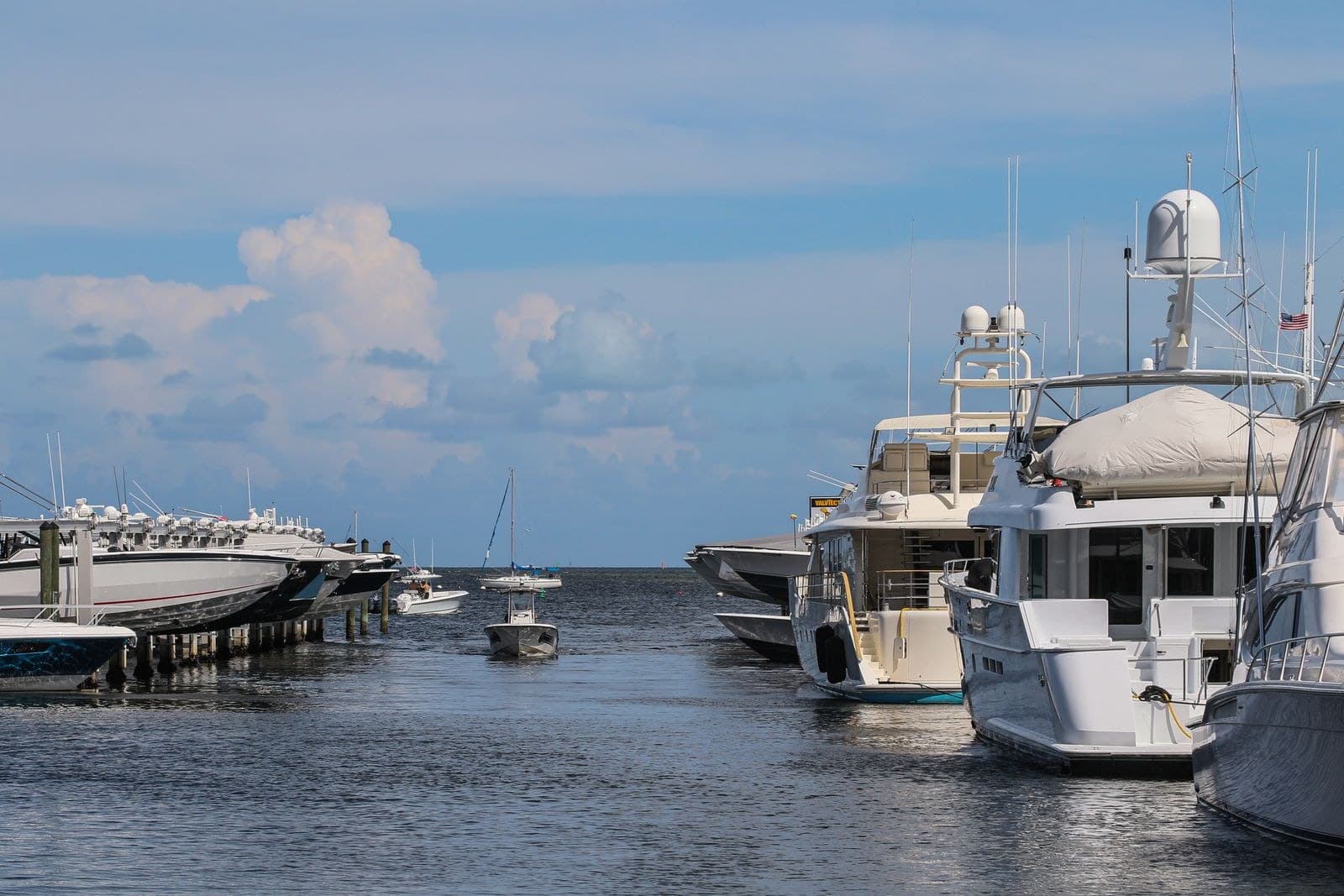
Survey, sign-off, load-in, departure clearance and the weather call: how a bartender booking for a yacht party runs, start to finish.
Quick summary (TL;DR)
Putting a bar on a yacht is not the same job as putting a bar in a garden. On shore you ask for a quote and then pick a date. On a boat, the space between the first quote request and the moment the vessel casts off is filled with work that has to happen in order: survey the boat, fix the guest count inside the vessel's carrying capacity, get a list of items signed off by the boat owner and the master, schedule the load-in, clear departure formalities, then make the go or no-go call on the weather. Drop one link and the whole party tilts.
This article follows that timeline end to end — from the first enquiry email to the moment the lines come off. Each stage states who does what, which documents are involved, and which deadlines cannot be pushed. Bar layout, drink quantities and on-water operating safety are covered separately in hiring a bartender and mobile bar for a yacht party; they appear here only where they touch the process.
One note on money: this article quotes no market rates for any charter operator. The cost of chartering the vessel is quoted by the boat owner and sits entirely outside the bar service quote. The only figures here come from Bartender.com.vn's own published price list.
Last updated: 05/08/2026.
| Key fact | Detail | Source |
|---|---|---|
| Time the port authority takes to process a vessel entering or leaving an inland waterway port or landing stage | 30 minutes from receipt of a complete document set (excluding seagoing vessels and foreign waterway craft) | Article 51.2, Decree 08/2021/ND-CP |
| Document that must be SUBMITTED to obtain departure clearance (passenger craft) | Passenger list | Article 53.1(a), Decree 08/2021/ND-CP |
| In thunderstorm or storm conditions | The vessel must not be allowed to leave the port or landing stage | Article 78.3(d), Law on Inland Waterway Transport (consolidated text 56/VBHN-VPQH) |
| Blood or breath alcohol for crew and operators on duty | Zero — there is no permitted minimum | Article 8.8, Law on Inland Waterway Transport (consolidated text) |
| Lifejackets on overnight tourist accommodation vessels | 200% of the total number of people on board, with half of them placed in the dining room, the bar room and work areas | QCVN 72:2025/BGTVT, Part 10 Chapter 1, clause 1.6.1 |
| Tourist transport vessel identification plate | Valid for 07 years and not beyond the vessel's remaining service life | Article 17.3, Decree 168/2017/ND-CP |
| Ice served in drinks on board | Classified by WHO as food; must be made from potable water | WHO, Guide to Ship Sanitation, 3rd ed. 2011, section 2.1.5 and Guideline 3.5 |
The whole process in six stages
Answer first: a bartender-staffed yacht party runs through six stages — enquiry, boat survey, configuration lock, contract and owner sign-off, load-in, and departure clearance. The first three decide whether the job is solvable at all; the last three decide whether it happens on the day you booked.
What makes this different from a shore party is the number of parties involved. A villa party has two: the client and the bar company. A yacht party has at least four: the client, the bar company, the boat owner or transport operator, and the master — the person with final authority on board. Add a fifth if the landing stage is under a port authority.
The master is not a formality in the chain. The law places a duty directly on that person: before departure, the master must check safety conditions for people and vessel, brief passengers on safety rules and on how to use safety equipment, and must not allow passengers to stand or sit in unsafe positions (Article 78.3(a)). Which means everything you build on deck has to leave room for that briefing to happen — the bar counter included.
So the governing rule of the whole process is plain: every item that touches the vessel must be confirmed in writing with the boat owner BEFORE the event day, not agreed verbally on the jetty that morning.
| Stage | Suggested timing | Client's job | Bar company's job | Vessel side |
|---|---|---|---|---|
| 1. Enquiry | T-30 days or earlier | Supply vessel details, guest count, time window | Return a price range and the list of missing information | — |
| 2. Boat survey | T-21 to T-14 | Get the owner's permission for the survey visit | Measure, photograph, log power, water and access | Send someone to open the boat |
| 3. Configuration lock | T-14 | Fix final guest count and menu | Issue the accurate quote, lock staffing | Confirm capacity and bar position |
| 4. Contract + sign-off | T-14 to T-7 | Sign the contract, pay the deposit | Send the confirmation list to the owner | Sign off each line item |
| 5. Load-in | T-0, before guests board | Finalise the guest list | Pack, transport, build the bar | Open the boat, assist the load |
| 6. Departure clearance | T-0, close to sailing time | Arrive on time | Report the bar as ready | Clear formalities, run the safety briefing, cast off |
Stage 1 — The enquiry: why the first answer is always a range, never a number
Answer first: because on a boat the price depends on things you can only see once you know the specific vessel — deck width, the way people get on and off, available power, and whether glassware is allowed at all. A published price list gives you a starting point; the final figure only exists after the survey.
Bartender.com.vn says as much directly under its package comparison: the displayed prices are indicative, and after assessing the actual needs of the event the consulting team will survey and issue an accurate quote before the contract is signed. For a shore party the gap between indicative and final is usually small. For a boat party, that gap is the entire logistics layer.
The way to shorten the enquiry loop is to send everything in the first email. The twelve fields below are what a person producing a real quote actually needs; without the first four, any number offered is guesswork. You can enter them straight into the quote request form or send them through the contact page.
One question people forget: is the vessel staying moored, or is it running a route? A yacht tied up at the pier for the whole party is much closer to a shore party — resupply is still possible, there is a walkway, and the deck is nearly still. A boat cruising the bay for three hours is a different problem entirely. The two scenarios differ in staffing, in quantities, and in the cancellation clause you need.
| # | Information to send with your enquiry | Why it moves the price |
|---|---|---|
| 1 | Vessel name and type, or a link or photos of the boat | Determines what size of bar can be built and where |
| 2 | Carrying capacity marked on the vessel | The hard ceiling on guest numbers — see stage 3 |
| 3 | Expected guest count | Number of bartenders, barbacks, volume of stock |
| 4 | Moored at the pier or running a route | Whether mid-party resupply is possible |
| 5 | Departure and return landing stage | Transport distance for stock, out-of-province surcharge |
| 6 | Timings: boarding, casting off, docking | Service hours, whether extended hours apply |
| 7 | Whether alcohol will be served | Menu, quantities, options for non-drinkers |
| 8 | Whether the galley will be in use during the party | Affects bar placement and fire safety clearance |
| 9 | Power available at the intended bar position | Whether blenders, chillers and bar lighting can run |
| 10 | Whether glassware is permitted on board | Changes the entire glass inventory and service style |
| 11 | Other suppliers on board: DJ, decor, catering | Deck space allocation and guest flow |
| 12 | A fallback date if weather forces a move | The postponement and cancellation clause |
Stage 2 — The boat survey: what to measure, what to photograph, whom to ask
Answer first: the survey is a purposeful 45 to 90 minute visit that produces three deliverables — a bar position diagram, a power, water and drainage log, and a list of questions for the boat owner. Without those three, an accurate quote does not exist.
Who should be there: the bar company's representative, the owner or the master, and if possible the client. The reason for having the client present is practical — most later disagreements come from expectations about where the bar will stand. Standing on the actual deck and pointing settles it in three minutes.
The most commonly missed item during a survey is the space already spoken for by regulation. For overnight tourist accommodation vessels, QCVN 72:2025/BGTVT requires that the vessel be fitted with lifejackets for 200% of the total number of people on board, of which 100% are placed in the sleeping cabins and the remaining 100% are placed in the dining room, the bar room and work areas. In other words, the bar area is by regulation a place where lifejackets must already be stowed — stacking an ice chest in front of that locker is not permitted, even if nobody notices during the party.
A scope caveat: the 200% figure applies to overnight tourist accommodation vessels. Day boats fall under different provisions. The safe move during a survey is to ask the master directly — where are the lifejackets on this boat, and does the spot I want for the bar block any of them.
The measuring itself is simple but must be complete. The clear width left after the bar is built is the single most important number: it decides both whether guests can walk past and whether the crew can work in an incident.
| Survey item | How to record it | What it changes |
|---|---|---|
| Deck footprint for the bar | Measure length × width, photograph all four corners | Whether a 1.5m, 3m or split bar is used |
| Clear width remaining after the build | Measure the through-width | Guest flow and escape routes |
| Boarding route: stairs, doorways, headroom | Measure and photograph | Whether the bar can be knocked down, what crate size fits |
| Number and location of sockets, available load | Photograph the panel, ask the engineer | Blenders, chillers, bar lighting |
| Fresh water source and drainage point | Photograph, ask tank capacity | Washing up, melt water disposal |
| Lifejacket lockers and lifesaving equipment | Photograph, mark on the diagram | No-build zone — see QCVN 72:2025 |
| Fire extinguishers and hydrants | Photograph, mark on the diagram | No-build zone |
| Galley location and whether it will be in use | Ask the master | Safe clearance from the bar |
| Waste and empties holding area | Agree on the spot | Handover plan at the end |
| Lashing points for heavy items | Photograph | Securing the bar and ice chests underway |
| Carrying capacity marked on the vessel | Photograph the marking itself | Hard ceiling on guest numbers |
| Safe draught mark | Photograph the hull side | Cross-check when loading |
Stage 3 — Locking the guest count: capacity is a hard number, not a negotiable one
Answer first: the maximum number of guests is the carrying capacity marked on the vessel minus every single working person boarding — crew, bartenders, barbacks, DJ, photographer, decorators. This subtraction is mandatory, not a rounding exercise.
The law frames it as a prohibition. Article 8.7 of the Law on Inland Waterway Transport lists among prohibited acts carrying more people than the vessel's carrying capacity, or loading beyond the safe draught mark. And that number is not filed away in a drawer: Article 24.1(b) requires the vessel to display the registration number, the safe draught mark and the permitted number of persons carried on the vessel itself. During the survey, photograph that marking.
The draught mark is likewise a dimensioned technical standard, not decorative paint. The law describes it as a painted line 25 millimetres wide and 250 millimetres long, running horizontally on both sides of the hull at the midpoint of the vessel's greatest length; the upper edge of the line is 100 millimetres from the gunwale for cargo vessels and 200 millimetres from the gunwale for passenger vessels. Knowing where that line sits explains why a master can turn away a last-minute delivery van.
In practice this subtraction lands hardest when the invitations are already printed. A vessel marked for 60 people, carrying 5 crew, plus a bar team of 3, a DJ, a photographer and 2 decorators staying aboard for the evening — the real guest ceiling is 48. If the list currently stands at 55, there are three options: fewer guests, fewer suppliers on board, or a different boat. There is no fourth option.
How to calculate drink volumes from guest numbers is covered in detail in how to estimate guest drink consumption for an event. On a boat only one thing changes: the resulting figure is no longer a shopping estimate, it is the final packing list.
| Capacity marked on vessel | Crew (assumed) | Service staff boarding | Real guest ceiling | Suggested bar configuration |
|---|---|---|---|---|
| 20 | 3 | 2 (1 bartender + 1 barback) | 15 | 1.5m bar, 1 bartender |
| 30 | 4 | 3 (2 bartenders + 1 barback) | 23 | 1.5m or 3m bar, 2 bartenders |
| 50 | 5 | 5 (2 bartenders + 1 barback + DJ + photographer) | 40 | 3m bar, 2 bartenders + supervisor |
| 80 | 6 | 7 (3 bartenders + 2 barbacks + DJ + photographer) | 67 | 3m bar plus a satellite station, coordinator on site |
| 120 | 8 | 9 (4 bartenders + 2 barbacks + DJ + photographer + decor) | 103 | Main bar plus 2 pouring stations, coordinator on site |
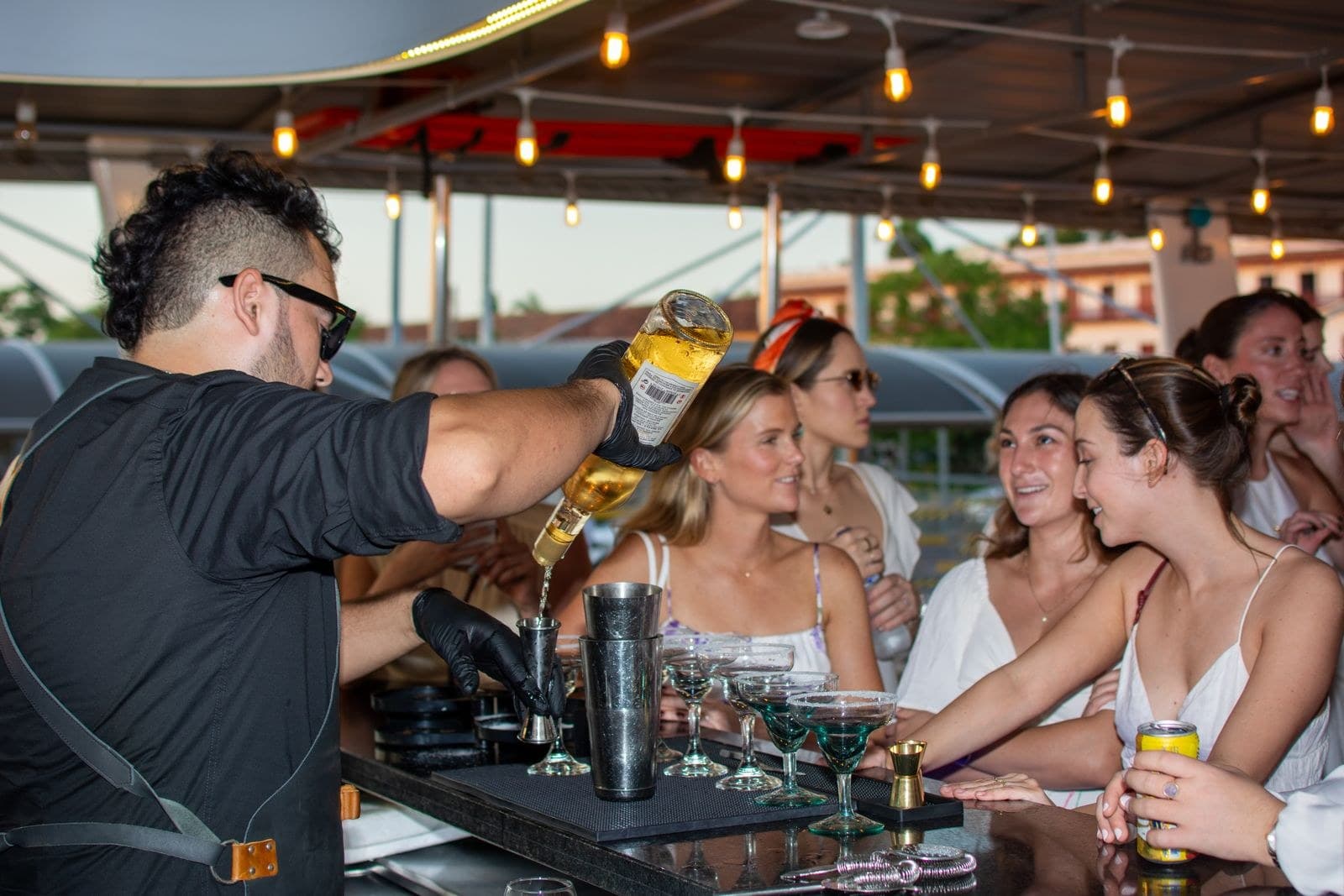
Stage 4 — The confirmation list for the boat owner and the master
Answer first: this is the stage fewest people bother with and the one that rescues the most parties. Its output is a single document listing every item that touches the vessel, with a signature box for the owner or the master, completed no later than seven days before the event.
Why a document rather than a chat message: the person who agreed you could build on the upper deck may not be the person driving the boat that day. The master carries a legal duty for safety before departure, so when confronted with a layout never approved, the only reasonable response is refusal. A signature obtained earlier turns that argument into a one-minute document check.
This is also the moment to check the legal standing of the operator. Since 24 September 2018, Decree 128/2018/ND-CP has repealed Articles 5, 7, 8, 9, 10 and clause 4 of Article 11 of Decree 110/2014/ND-CP and replaced Article 6 with a single sentence: the transport business unit must be established as an enterprise or a cooperative under Vietnamese law. The business conditions have been trimmed, but obligations on vessel survey, crew certification and insurance remain in force — they simply live at statute level and in other sector-specific instruments rather than in Decree 110.
For vessels carrying a tourist transport identification plate there is a figure that is frequently reported incorrectly: many sources say the plate is valid for 5 years, following a superseded instrument. The instrument in force says otherwise — Decree 168/2017/ND-CP provides that the plate is valid for 07 years and not beyond the vessel's remaining service life. When you look at the plate on the boat, read the expiry date printed on it rather than inferring one.
On crew documents, the issuing authority changed recently. Circular 09/2025/TT-BXD, effective 1 July 2025, amended Article 7 of Circular 40/2019/TT-BGTVT to read: the Department of Construction organises examinations, issues decisions recognising examination results, and grants, re-grants and converts certificates of professional competence for masters of class four and above and for chief engineers of class three and above. You do not need to vet crew certificates yourself — that is the owner's responsibility — but it helps to know which office issues them now.
| Item to confirm | Who confirms | Evidence to hold | Risk if skipped |
|---|---|---|---|
| Exact bar position on deck | Master | Signed diagram or annotated photo marked approved | Ordered to move the bar just before guests board |
| Maximum number of guests allowed that day | Boat owner | Written statement of the number | Guests arrive over the limit and some stay ashore |
| List of bar equipment permitted aboard | Master | Line-by-line ticked list | Equipment turned away at the jetty |
| Whether glassware is permitted | Master | Stated in the confirmation document | Entire glass inventory swapped at the last minute |
| Power: which sockets, what load | Engineer on duty | Photo of the panel plus written load figure | Breaker trips mid-party |
| Fresh water for the bar and drainage point | Crew | Confirmed usable capacity | Runs out of wash water mid-service |
| Load-in window on board | Owner / landing stage management | Schedule with specific times | Waiting on the jetty, losing build time |
| Waste and empties holding area | Master | Confirmed location | Argument at handover |
| Whether shore ice may be brought aboard | Master | Confirmation plus storage arrangement | Ice refused, entire chilled service lost |
| Bad weather plan: postpone, cancel, deposit treatment | Owner + client | Contract clause | Money lost at both ends with nobody accountable |
| Third party liability insurance for the vessel | Boat owner | Copy of a valid certificate | Unclear who compensates in an incident |
| Valid tourist transport identification plate | Boat owner | Photo of the plate with a readable expiry date | Legal exposure attaches to the trip |
Stage 5 — The accurate quote and the contract: charter cost is not part of the bar quote
Answer first: the bar service quote and the vessel charter cost are two separate invoices from two separate legal entities. The bar quote covers staff, the bar unit, ingredients, glassware, tools and travel; the charter is quoted by the boat owner and does not pass through us.
Saying this early avoids the most common misunderstanding in the yacht party segment: the client compares the bar quote against the total budget for the whole evening. The two figures do not cover the same scope. Charter cost depends on vessel class, hours, route and season — we do not quote it on the owner's behalf and we take no commission on it.
Our own scope has a published price list. The Bartender.com.vn price page states that all prices include 10% VAT, mobile bar setup, ingredients (spirits, mixers, ice, garnish, fruit), glassware, bar tools and inner-city travel; out-of-province surcharges are calculated per kilometre and itemised transparently in the detailed quote. For yacht parties the out-of-province surcharge is the line that appears most often, because Vietnam's strongest yachting destinations all sit outside the city where the team departs from.
The three packages below are the standard configurations. On a boat, the variable that most often shifts the package is not guest count but hours: a bay cruise typically runs longer than a shore cocktail hour, so the extended hour add-on shows up far more frequently.
On contracts, there are two clauses a shore party does not need and a boat party cannot go without. The first is the weather threshold that triggers postponement or cancellation, together with how the deposit is treated. The second is where responsibility sits when the master changes the layout for safety reasons — which side absorbs the resulting cost. How to break down the cost of a mobile bar by size is covered in mobile bar cost at 5m, 10m and 30m.
| Item | Essential | Signature | Bespoke |
|---|---|---|---|
| Entry price | From 4.5m VND | From 12m VND | From 28m VND |
| Bartenders | 1 Standard | 2 Senior + supervisor | Master + 2 Senior + coordinator |
| Service duration | 3 hours | 4 hours | 5+ hours depending on the event |
| Mobile bar | 1.5m basic | 3m branded | Custom branded mobile bar |
| Cocktail menu | 6 classics | 4 classics + 2 signatures | 6+ classics + unlimited signatures |
| Standby bartender | No | Yes | Yes |
| Event coordinator | No | Yes | Yes |
| Out-of-province surcharge | Per kilometre | Per kilometre | All-inclusive destination package |
| Add-on | Published price | Why yacht parties use it |
|---|---|---|
| Extended hour | 2,500,000 VND per hour, ingredients included | Bay cruises usually run longer than the standard service window |
| Additional signature drink | 1,500,000 VND | A drink built around the theme of the trip |
| Extended mocktail menu | 800,000 VND for 4 additional alcohol-free drinks | There is always someone operating the vessel, plus children and non-drinkers |
| Cocktail hour photographer | 3,500,000 VND | The water backdrop is the main reason people choose a yacht |
| Branded coasters, 200 pieces | 1,200,000 VND | Corporate events on board need brand presence |
| 15-minute flair show | 5,000,000 VND | Needs separate approval from the master because of fire and space |
Stage 6 — The load-in schedule: one trip aboard, and there is no second one
Answer first: the load-in schedule runs backwards from the boarding time, not forwards from when the team arrives. The anchor point is the moment guests step onto the gangway; everything else counts back from there, and the minimum buffer for a 3m bar should be 90 minutes.
The big difference from a shore party sits right here: on shore, if something is missing you drive out and buy it; on a boat, the inventory at departure is the final inventory. So the packing stage has to be checked twice by two different people, and every crate needs a label so nobody has to empty three boxes on deck looking for a bottle of syrup.
Ice is the item that demands the most discipline and gets the least. The WHO says plainly in its Guide to Ship Sanitation that on ships, ice supplied to ships or manufactured on board for both drinking and cooling is classified as food. That is not a figure of speech — it means ice has to be handled as food, not as a consumable.
In detail, the WHO guidance requires that ice that will come in contact with food or drink needs to be manufactured from potable water; shore sources must be checked with the local health authority, and delivery of ice from shore to ship must be carried out in a sanitary manner; upon delivery to the ship, shore ice needs to be handled in a sanitary manner, the handler wearing clean clothing, gloves and boots; ice must be stored in a clean storage room and raised off the surface by use of deck-boards or similar devices permitting drainage and free flow of air. All three requirements — protective clothing, clean storage, raised with drainage — are achievable on a mid-sized yacht, provided you know about them in advance.
One more design detail from the same source, worth remembering when you build on a sloping deck: drop-in units in the counter such as ice wells and bains-marie must be protected with a raised edge or rim of 5 mm or more above the counter level around the opening. On shore that is a hygiene detail; afloat it also stops spillage running back in.
Finally, do not push the build into the window when guests are already aboard. Beyond the look of it there is a safety reason: the master needs a clear deck to deliver the pre-departure briefing.
| Milestone | Task | Who | Condition to move on |
|---|---|---|---|
| T-1 day | First packing check, crates labelled | Bar team | 100% of the list present, no missing lines |
| T-1 day | Reconfirm the boat opening time with the owner | Coordinator | Written response received |
| T-4 hours | Second packing check by a different person, collect ice | Bar team | Correct ice type and volume, sealed cold boxes |
| T-3 hours | Van arrives at the landing stage, stages at the agreed point | Bar team | Cleared to enter by landing stage management |
| T-2.5 hours | Carry stock aboard, ice handlers in protective clothing | Bar team + crew | Within the confirmed window |
| T-2 hours | Build the bar, lash it to fixing points, connect power | Bar team | No lifejacket locker or extinguisher obstructed |
| T-1.5 hours | Set out tools, cut garnish, complete mise en place | Bar team | Bar stays firm under a shake test |
| T-45 minutes | Dry run: make two sample drinks, test power and water | Head bartender | All equipment functioning |
| T-30 minutes | Clear the deck, return spare gear to storage | Bar team | Deck clear for the safety briefing |
| T-15 minutes | Report to the master: bar ready | Coordinator | Master acknowledges |
| T-0 | Guests board | — | — |
Departure clearance: thirty minutes and a passenger list
Answer first: clearance for a vessel entering or leaving an inland waterway port or landing stage is handled by the port authority within 30 minutes of receiving a complete document set, and for passenger craft the document that must be submitted for departure clearance is the passenger list. That is the operator's job, but it constrains your guest list deadline directly.
Decree 08/2021/ND-CP provides at Article 51.2: processing time: within 30 minutes from receipt of the documents required under the regulations, except for seagoing vessels and foreign waterway craft. Those thirty minutes only start counting once the file is complete — so a guest list sent late does not delay the thirty minutes, it delays the starting point.
On the departure file itself, Article 53.1(a) states that the document to be submitted is the passenger list (for passenger transport craft), while the documents to be produced include the carriage contract or waybill or goods release note, and crew certificates of professional competence if these have changed since the vessel entered. In the other direction, Article 52 lists what must be produced on arrival — including third party liability insurance (for vessels subject to compulsory third party liability insurance).
A fair question arises: are these provisions still current, given that Decree 08/2021 has since been amended? They are. Decree 06/2024/ND-CP of 25 January 2024, effective from 10 March 2024, amends only Articles 15, 16, 18 and 20 and replaces Forms 13 and 16 — we read the whole of Article 1 of that decree in the digitally signed Official Gazette PDF, and Articles 51 to 54 are not on the list. The document metadata can be cross-checked on the Government legal document portal.
The operational consequence is concrete: your guest list deadline has to fall at least an hour before departure, and any change after that — one extra friend, one swapped name — stops being a matter of courtesy and becomes a matter of paperwork. Tell the client this when the contract is signed, not while standing on the jetty.
A smaller point that comes up with parties held on long-moored vessels: Article 54.5 provides that a vessel already granted departure clearance but still lying in the port or landing stage waters for more than 24 hours must have its departure permit reissued to adjust the departure time.
| Topic | Provision | Article | What you need to do |
|---|---|---|---|
| Port authority processing time | 30 minutes from receipt of a complete file | Article 51.2, Decree 08/2021 | Send the guest list early so the clock starts early |
| Document to SUBMIT for departure | Passenger list (passenger craft) | Article 53.1(a), Decree 08/2021 | Close the guest list at least 1 hour before departure |
| Documents to PRODUCE for departure | Carriage contract or waybill or goods release note | Article 53.1(b), Decree 08/2021 | The operator's job — confirm they hold them |
| Third party liability insurance | Produced when clearing arrival at the port or landing stage | Article 52.2(e), Decree 08/2021 | Request a copy of a valid certificate from the owner |
| Lying over 24 hours after departure clearance | Departure permit must be reissued | Article 54.5, Decree 08/2021 | If the party runs past midnight, ask whether the owner has handled it |
| Clearance format | In person at the port authority, or electronically via the portal | Article 51.1, Decree 08/2021 | Ask in advance so you know the document cut-off |
| Whether the above is still in force | Not amended by Decree 06/2024/ND-CP | Article 1, Decree 06/2024 amends only Articles 15, 16, 18, 20 and Forms 13, 16 | — |
The go or no-go decision: settle the weather in advance, not on the jetty
Answer first: the decision to sail belongs to the master, and the law already fixes one absolute threshold — in thunderstorm or storm conditions the vessel must not leave. What the contract has to do is define the thresholds BELOW that prohibition, so that nobody is arguing on the morning of the event.
The hard threshold sits at Article 78.3(d) of the Law on Inland Waterway Transport: in thunderstorm or storm conditions the vessel must not be allowed to leave the port or landing stage; if the vessel is already underway it must seek safe shelter. That is not negotiable and there is no exception for a wedding with printed invitations.
But most bad days are not storm days. They are days of force 5 to 6 wind, where the boat can still sail but a bar on an open deck cannot work. To talk to the owner and the client in the same language, use the Beaufort scale — the scale that Admiral Sir Francis Beaufort developed in 1805 to help sailors estimate winds by visual observation, running from force 0 to force 12 and still in use today.
The UK Met Office publishes the conversion from wind force to wave height and describes the scale as an empirical measure for describing wind intensity based on observed sea conditions, used in Met Office marine forecasts. One caveat has to be stated plainly: the Met Office itself notes that those wave height values refer to well-developed wind waves of the open sea. Sheltered bays such as Ha Long or Nha Trang will run considerably lower — do not apply open-sea figures to a bay.
How to use the table below in practice: put it in an annex to the contract, pick one specific threshold as the trigger for postponement, and write down who decides, at what hour, and based on whose forecast. Any threshold will do, as long as it is chosen in advance. The worst outcome is not strong wind; it is two parties who never agreed how strong is too strong.
And set the decision hour earlier than the load-in. A call made after the van has left the warehouse is a late call — the ice is bought, the garnish is cut, the staff are dispatched.
| Beaufort force | Wind speed (knots) | Description | Typical open-sea wave height (m) | What it means for an open-deck bar |
|---|---|---|---|---|
| 3 | 7–10 | Gentle breeze | 0.6 | Normal; watch light napkins and garnish |
| 4 | 11–16 | Moderate breeze | 1.0 | Weight the paper down, use heavy-based glasses; service still fine |
| 5 | 17–21 | Fresh breeze | 2.0 | Where it starts to get difficult at sea; consider moving under cover |
| 6 | 22–27 | Strong breeze | 3.0 | Pouring and shaking on an open deck is close to impossible at sea |
| 7 | 28–33 | Near gale | 4.0 | Do not build an outdoor bar |
| 8 | 34–40 | Gale | 5.5 | No longer a question about the bar |
Service timeline underway: anchor to the vessel's milestones, not to a clock
Answer first: the service plan has to hang off the trip's own milestones — boarding, safety briefing, casting off, the run, the scenic stop, the return leg, docking — rather than off the minute-by-minute schedule of a shore party. The vessel's milestones are fixed; the party's are elastic.
The milestone most often underrated by service teams is the safety briefing. It is the master's legal duty before departure, cited at the top of this article. During it the bar should stop serving and the bartenders should stand still like guests — both so guests can hear, and because the bar team also needs to know where the lifejackets are.
The strongest service window is usually the first twenty minutes after casting off. Guests have just boarded, the boat is clearing the moorings, and everyone wants a glass in hand for photographs. If there is a welcome drink, pour it onto trays before boarding rather than making it to order — a principle set out in detail in the cocktail hour checklist for 30, 60 and 90 minutes.
One legal constraint the bar team must understand and never relax: alcohol and the people operating the vessel. Article 8.8 of the Law on Inland Waterway Transport prohibits crew members and vessel operators working on board from having alcohol in their blood or breath, or any other stimulant banned by law. This is a zero threshold — there is no permitted minimum. Many Vietnamese websites still quote figures such as 50 milligrams per 100 millilitres of blood or 0.25 milligrams per litre of breath as the current rule; those numeric thresholds belong to the superseded text and have been replaced by an absolute prohibition.
Operationally that translates into a simple rule at the counter: the bar does not serve alcohol to anyone working on the vessel, even if that person is a friend of the client, even if they say their shift is over. Always have an alcohol-free option ready for this group — which is why the extended mocktail menu add-on appears in almost every yacht party that serves alcohol.
Building a drinks menu around guest numbers and budget works the same afloat as ashore in principle; it just cannot be revised mid-trip. See how to build a drinks menu for a party.
| Trip milestone | What the bar does | Note |
|---|---|---|
| Guests board | Welcome drinks pre-poured on trays | No made-to-order pours; keep the deck clear |
| Master's safety briefing | Stop service, bar team listens with the guests | Legal duty before departure |
| Casting off | Re-secure everything on the counter before the boat moves | The deck starts to heel and vibrate |
| First 20 minutes underway | Peak service, all hands at the counter | Everyone wants a glass for photographs |
| Steady run | Serve to order, build signature drinks | Best window for a flair show if it has been approved |
| Scenic stop or swim stop | Slow down, move to light drinks and water | Guests leave the bar; do not batch ahead |
| Return leg | Second peak, start withdrawing spare tools | Serve and pack down at the same time |
| 30 minutes before docking | Stop taking new orders, break down the bar | Deck needs to be clear for docking |
| Docking | Full stop, prepare for handover | No guest should carry a glass down the gangway |
Breakdown and handover: the return leg is when things go missing
Answer first: the handover is a short signed record made on board before the team leaves the jetty, reconciling three things — the condition of the deck, the number of crates going ashore, and whether waste ended up where it was agreed. Skip it and every later disagreement is one person's word against another's.
Waste is the most reliable source of friction between a bar company and a boat owner, because no refuse truck passes a yacht. Every empty bottle, every litre of melt water, every leftover garnish and every disposable cup has to travel back to shore. Bags must be sealed, the holding area must have been agreed back at stage 4, and nothing whatsoever goes over the side.
Lost equipment almost always happens on the return leg, when the team is tired and the light is poor. The fix is unglamorous: count crates on the way up, count crates on the way down, have the same person do both, and write the numbers into the record. Small tools — jiggers, strainers, bar spoons — belong in a dedicated case rather than loose on the counter.
Finally, photograph the deck after the breakdown from the same angle used during the survey. Two photographs side by side settle almost every question about a scratch or a stain.
| Handover item | How to check | What goes in the record |
|---|---|---|
| Deck surface in the bar area | Photograph from the same angle as the survey shot | New damage: yes or no |
| Power connection point | Unplug, check the breaker | Returned to original state |
| Lifejackets and extinguishers | Confirm they are back in their original positions | Returned and unobstructed |
| Crates loaded aboard versus taken ashore | Counted by the same person both times | The two numbers must match |
| Small tools | Checked as a case, not loose | Complete or missing, item named |
| Waste and empties | Staged at the agreed location | Handed over to whom |
| Waste water and melt water | Discharged at the confirmed point | Nothing discharged over the side |
| Signatures | Bar company representative + vessel representative | Date and time of handover |
The four most common failures and how to block them at the enquiry stage
Answer first: nearly every yacht party incident traces back to a question not asked at stage 1 or an item not signed at stage 4. The four situations below account for most failures, and all four are blocked by paperwork rather than by experience.
The most expensive is being over capacity. It is expensive because there is no on-the-spot fix: when the head count exceeds capacity, the person left ashore is a real person, usually a guest of the host. The only prevention is doing the capacity subtraction at stage 3 and writing that number into the contract, not into a message thread.
The most irritating is being told to move the bar at the last minute because it blocks safety equipment. It is irritating because the master is right and you have nothing to argue with. The prevention is marking lifejacket lockers and extinguishers on the diagram during the survey, then getting that diagram signed off.
The most costly is a weather cancellation where nobody defined the cancellation threshold beforehand. The ice is bought, the ingredients are cut, the staff are dispatched — the cost has been incurred even though the boat never left. A weather clause does not protect you from weather, but it does protect the relationship between the parties.
If you are considering a party on board and want a quick check on whether these four points are covered, send your details through the quote form or read the service overview to see where our responsibility begins and ends.
| Failure | Root cause | Stage that blocks it | What to do |
|---|---|---|---|
| More guests than capacity allows | Service staff not subtracted from capacity | Stage 3 | Write the real guest ceiling into the contract |
| Ordered to move the bar before boarding | Bar blocks lifesaving or firefighting equipment | Stages 2 and 4 | Mark them on the diagram and get it signed off |
| Weather cancellation with nobody absorbing the cost | Contract defines neither threshold nor decision hour | Stage 5 | Pick a Beaufort threshold and a decision time in an annex |
| Breaker trips mid-party | Available load at the socket never confirmed | Stages 2 and 4 | Get the load confirmed in writing by the engineer |
| Ice refused at the jetty | Shore ice never discussed in advance | Stage 4 | Confirm the ice source and the storage arrangement |
| Guest list finalised too late | Nobody knew the passenger list is a submitted document | Stage 1 | Set the list deadline at least 1 hour before departure |
In closing
Booking a bartender for a yacht party is no harder than a shore party in terms of mixing, but it is considerably harder in terms of sequence. On shore, a mistake can be fixed in twenty minutes. On a boat, each step closes a door behind it: you cannot quote accurately until the survey is done, you cannot load until the sign-off is signed, you cannot sail until the load is complete, and once the vessel has cast off the inventory on the counter is the final inventory.
So the measure of a good process is not how many cocktails are on the menu. It is how many questions were answered before the lines came off.
The distance between a smooth yacht party and a difficult one lies not in the bartender's skill, but in whether the guest count, the bar position, the power supply and the weather threshold were signed off with the boat owner before the day of the event.
If you are planning a party on board, start by sending the vessel details and expected guest count through the quote request form. Review the packages and add-ons to see what falls inside the bar service, or get in touch directly if the date is already close.
FAQ
How much lead time does a bartender-staffed yacht party need?
Three weeks minimum for a mid-sized event: roughly one week for the enquiry and scheduling the survey, one week for the survey and configuration lock, one week for the contract and the owner confirmation list. It can be done in less if the vessel is familiar and the information is already to hand, but the safety margin narrows considerably.
Is the vessel charter cost included in the bar quote?
No. They are two invoices from two separate legal entities. Our quote covers staff, the bar unit, ingredients, glassware, tools and travel; the charter is quoted by the boat owner directly to the client.
Who decides whether the boat sails in bad weather?
The master. The law provides that in thunderstorm or storm conditions the vessel must not be allowed to leave the port or landing stage. Milder conditions are governed by the contract — pick a specific threshold and a decision hour when you sign.
How is the maximum guest number calculated?
Take the carrying capacity marked on the vessel and subtract everyone working on board that day, including crew and all service staff. Carrying more people than the vessel's capacity is a prohibited act under the law.
Does a guest list have to be submitted in advance?
For passenger transport craft, the passenger list is a document that must be submitted when clearing departure from the port or landing stage. In practice this means the list has to be closed before departure, and last-minute changes stop being a courtesy issue.
Is glassware allowed on board?
It depends on the vessel and on the master. We found no Vietnamese legal provision banning glassware on passenger craft; restricting glass on deck is a widespread industry practice adopted for safety reasons, not a statutory duty. So ask, and put the answer in the confirmation document rather than assuming.
Can the person driving the boat have a drink?
No, absolutely not. The law prohibits crew members and vessel operators working on board from having any alcohol in their blood or breath. This is a zero threshold with no permitted minimum.
Does a party on a permanently moored vessel need this whole process?
Yes, but a lighter version. A moored vessel still clears formalities, still has a capacity limit and still needs owner confirmation; the difference is that resupply remains possible and weather risk is much lower. If budget or lead time is tight, this is the option worth considering first.
Is there a problem with bringing ice from shore?
There is, if you do not prepare. WHO guidance classifies ice on board as food and requires it to be made from potable water, delivered in a sanitary manner, handled by staff wearing clean clothing, gloves and boots, and stored raised off the surface to allow drainage and air flow.
Sources
Law on Inland Waterway Transport, consolidated text 56/VBHN-VPQH — digitally signed Official Gazette PDF, Government Portal. Used for Article 8.7, Article 8.8, Article 24.1(b), Article 24.3(d), Article 78.3(a) and 78.3(d): https://datafiles.chinhphu.vn/cpp/files/vbpq/2026/3/56-vbhn-vpqh.pdf
Decree 08/2021/ND-CP of 28 January 2021 on the management of inland waterway activities — digitally signed Official Gazette PDF (scanned; pages 55 and 56 read as images). Used for Article 51.2, Article 52, Article 53.1 and Article 54.5: https://datafiles.chinhphu.vn/cpp/files/vbpq/2021/02/08.signed.pdf
Decree 06/2024/ND-CP of 25 January 2024 amending Decree 08/2021/ND-CP — digitally signed Official Gazette PDF (scanned; the whole of Article 1 and Article 3 read as images). Used to confirm that Articles 51 to 54 of Decree 08/2021 were NOT amended: https://datafiles.chinhphu.vn/cpp/files/vbpq/2024/01/06-nd-cp.signed.pdf
Document record for Decree 06/2024/ND-CP on the Government Portal (metadata: issued 25-01-2024, effective 10-03-2024, signed by Tran Hong Ha): https://vanban.chinhphu.vn/?pageid=27160&docid=209595&classid=1
Decree 128/2018/ND-CP of 24 September 2018 amending investment and business conditions in the inland waterway sector — digitally signed Official Gazette PDF. Used for the repeal of Articles 5, 7, 8, 9 and 10 of Decree 110/2014 and for the new Article 6: https://datafiles.chinhphu.vn/cpp/files/vbpq/2018/09/128.signed.pdf
Decree 110/2014/ND-CP of 20 November 2014 on business conditions for inland waterway transport — digitally signed Official Gazette PDF (scanned). Used to check the original text before amendment: https://datafiles.chinhphu.vn/cpp/files/vbpq/2014/11/110.signed.pdf
QCVN 72:2025/BGTVT — national technical regulation issued with Circular 02/2025/TT-BGTVT, published in Official Gazette 223+224 of 31 January 2025. Used for Part 10 Chapter 1 clause 1.6.1 on the 200% lifejacket requirement and the bar room: https://congbaocdn.chinhphu.vn/CongBaoCP/VanBan/2025/1/43936/54440-1-2025223-22402-2025-tt-bgtvt.pdf
Decree 168/2017/ND-CP of 31 December 2017 detailing articles of the Law on Tourism — Official Gazette PDF 429+430 of 10 March 2018. Used for Article 17.3 on the 07-year validity of the identification plate: https://congbaocdn.chinhphu.vn/CongBaoCP/VanBan/2017/12/26028/21615-1-2018429-430168-2017-nd-cp.pdf
Circular 09/2025/TT-BXD of 13 June 2025, Ministry of Construction, effective 1 July 2025 — Official Gazette PDF 911+912 of 17 July 2025. Used for Article 19.1 amending Article 7 of Circular 40/2019/TT-BGTVT on the authority to issue certificates of professional competence: https://congbaocdn.chinhphu.vn/CongBaoCP/VanBan/2025/6/45399/57384-1-2025911-91209-2025-tt-bxd.pdf
World Health Organization, Guide to Ship Sanitation, Third edition, Geneva 2011, ISBN 978 92 4 154669 0 — PDF retrieved via the IRIS DSpace REST API (the WHO landing page is live but the PDF link on it is broken, and the usual bitstream URLs return an empty HTML shell). Used for section 2.1.5 page 18, Guideline 3.3 page 68 and Guideline 3.5 page 71: https://iris.who.int/server/api/core/bitstreams/aadd4839-673b-4250-b6a2-2d6b7f55b7de/content
Met Office (United Kingdom), Beaufort wind force scale — wind force, wind speed and wave height table used in Met Office marine forecasts: https://www.metoffice.gov.uk/weather/guides/coast-and-sea/beaufort-scale
NOAA — National Weather Service (United States), Beaufort Wind Scale — history and description of the scale developed by Admiral Sir Francis Beaufort in 1805: https://www.weather.gov/mfl/beaufort
Packages and add-ons quoted from the public Bartender.com.vn price page, read on 05/08/2026: https://bartender.com.vn/en/pricing
Note on a source we could not use: we attempted to cite the marine forecast bulletin of Vietnam's National Center for Hydro-Meteorological Forecasting for the weather section, but the bulletin content on that site is loaded by JavaScript and could not be quoted verbatim — so the article relies solely on the Met Office and NOAA Beaufort material for its wind figures.


Planning an event?
Get a free quote
Tell us about your event and our team will recommend the right package and send a detailed quote — no commitment.