Planning
Hiring a Bartender and Mobile Bar for a Yacht Party: Layout, Logistics and Safety on the Water
bartender.com.vn · 03/08/2026 · 24 min read
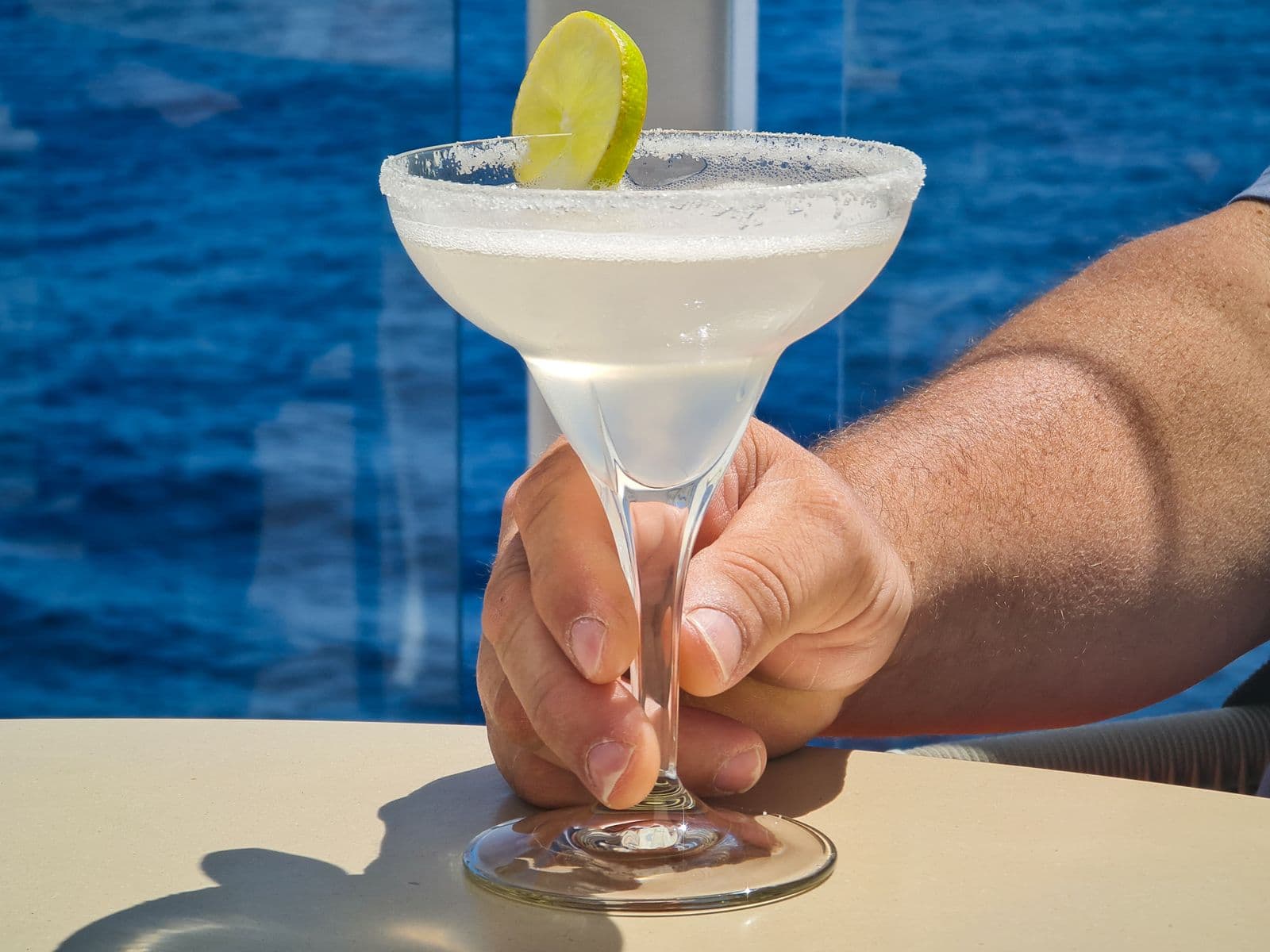
Bar layout, logistics, drink planning, safety and costing when you hire a bartender and mobile bar for a yacht party in Vietnam.
Quick summary (TL;DR)
Last updated: 3 August 2026.
Short answer: hiring a bartender and a mobile bar for a yacht party differs from hiring one for a party on shore in three hard constraints — the floor moves, the floor area cannot be expanded, and there is no resupply mid-event. The correct sequence is therefore to survey the deck together with its power and water supply first, lock the bar length, and only then lock the menu and the number of bartenders. Ice has to be managed as food rather than as a consumable, and every quantity needs a thicker contingency margin than on shore.
The three facts most worth remembering: the World Health Organization classifies ice used for drinking or for chilling on board as food; the opening of an ice well recessed into a bar top must have a raised coaming of at least 5 mm; and from Beaufort force 5 upward, corresponding to open-sea waves of about 2 m, pouring and shaking on an open deck is close to unworkable. And the national technical code for inland waterway vessels names the bar room as one of the places that must hold life jackets.
On the legal side, the two provisions that govern every party serving drinks on board in Vietnam both sit in Vietnam's Law on Prevention and Control of Alcohol Harms: it is prohibited to sell or supply alcoholic drinks to anyone under 18, and it is prohibited for a person operating a means of transport to drink alcohol — the latter applies directly to the captain and the crew operating the vessel, not to the guests.
The takeaway: a bartender party on a yacht is not decided on the deck, but at the vessel survey and on the stock count sheet at the foot of the gangway.
| Fact | Value | Source |
|---|---|---|
| Classification of ice on board (both drinking ice and chilling ice) | classified as FOOD | WHO, Guide to ship sanitation, 3rd ed. 2011 |
| Minimum coaming around the opening of an ice well or bain-marie recessed into the bar top | at least 5 mm above the bar top | WHO, Guide to ship sanitation, 3rd ed. 2011 |
| Minimum free residual chlorine at the water supply point on board | 0.2 mg/L | WHO, Guide to ship sanitation, 3rd ed. 2011 |
| Receiving temperature for milk and dairy products loaded on board | 5 °C or below | WHO citing Codex Alimentarius, Table 3-2 |
| Ship-associated infectious disease outbreaks recorded 1970–2003 | more than 100 outbreaks; 2 in 5 foodborne, 1 in 5 waterborne | WHO citing Rooney et al., 2004 |
| Open-sea waves corresponding to Beaufort force 5 | about 2.0 m (maximum 2.5 m) | Met Office, Beaufort wind force scale |
| Life jackets on overnight tourist accommodation vessels — the code names the bar room explicitly | enough for 200% of all people on board | QCVN 72:2025/BGTVT, Part 10 clause 1.6.1 |
| Minimum age for being sold or supplied alcoholic drinks in Vietnam | 18 years of age | Law 44/2019/QH14, Article 5 |
How a bar on a yacht differs from a bar on shore
Short answer: it differs in three things that are not negotiable — the floor does not stay still, the floor area cannot be expanded, and there is no resupply line mid-event. Every other decision about the menu, the staffing, the glassware and the quantities follows from those three constraints.
On shore, a 3m mobile bar set up in a garden can be shifted, an extra socket can be plugged in, and if you run out of limes, limes arrive twenty minutes later. On a boat, none of that holds: the bar stands exactly where the survey put it, every consumable has to come aboard at the start, and the only thing still elastic is the service plan. That is why the most demanding part of a yacht party is not mixing drinks but surveying and packing.
The sloping, vibrating floor is the clearest technical difference. On a static flat surface, a stemmed glass sitting near the edge of the bar is still safe; on a deck, that same glass slides the moment the boat takes a wave on the beam. Bartenders used to fixed bars usually lose their rhythm in the first fifteen minutes because every hand habit has to change: everything needs a bracing point, every bottle sits in a lipped tray, and the shaking motion has to change axis so nothing flies off. This is not only trade experience — the WHO standard for bar design on ships requires a raised coaming of at least 5 mm around the opening of any well recessed into the bar top, such as an ice well or a bain-marie, precisely to stop dirty water flowing back in when the bar top tilts.
Floor area is the second constraint. On a yacht, every square metre of bar takes exactly one square metre away from where guests stand — a straight subtraction, not a rearrangement. A 3m bar plus the working space behind it consumes roughly four to five square metres of deck, the equivalent of eight to ten standing guests. On a smaller boat, that is a sound reason to choose a 1.5m bar and make up the difference with roaming service trays instead of forcing a large bar into the space.
The third constraint is one-way logistics. A party on shore allows mistakes to be corrected; a party on a boat does not. Once the vessel has left the pier, the inventory on board is the final inventory until it docks again. That pushes all the risk forward — onto listing and counting the stock — and that is also where the time is best invested. If you are comparing this with an on-shore party you have already run, our article on hiring a bartender for an event: class and polish describes the common framework, while this one covers only what the vessel changes.
The takeaway for this section: the biggest difference between a bar on shore and a bar on a boat is not mixing technique but the fact that a vessel allows no corrections once it has left the pier.
| Item | Party on shore (villa, rooftop, function hall) | Party on a yacht |
|---|---|---|
| Floor | Flat and static | Tilts with the swell, vibrates with the engine; everything needs a bracing point |
| Bar footprint | Flexible, can be moved | Fixed by the survey; every square metre of bar is subtracted straight from guest standing space |
| Resupply during the party | Extra stock bought within 15–30 minutes | None. The inventory at departure is the final inventory |
| Power | Stable mains sockets | Depends on the vessel's generator or batteries; capacity is limited and must be checked in advance |
| Water for the bar | Tap on site | Finite tank capacity; water used in drinks must be of drinking-water quality |
| Waste | Disposed of at the venue | Carried back to shore; needs sealed bags and a storage corner agreed in advance |
| Glassware | Usable by default | Decided deck by deck: broken glass on a wet deck is a real risk |
| Cancellation plan | Move the time, change the room | Depends on the weather and the vessel schedule; the cancellation threshold must be fixed in the contract |
Getting everything aboard: you only get one trip
Short answer: the logistics of a yacht party are decided on the pier, not on the deck. All the equipment, ingredients, ice and glassware have to pass through one narrow boarding route, within a short window, with no second run — which makes the packing list the real blueprint of the party.
The boarding route determines your case sizes. The gangway of a typical tour vessel usually takes one person carrying one medium-sized case, and often has steps. Splitting the load into many manageable cases is therefore always faster than a few large ones: a forty-kilo ice chest needs two people and blocks the gangway exactly when guests are about to board, whereas four ten-kilo chests can be carried by four people in parallel.
Setup on board takes longer than on shore because of the extra moving and securing. A bar that takes about an hour to build at a villa should be budgeted at one and a half times that on a boat, and all of it has to be finished before guests start boarding. The reason is simple: once guests are on deck, every lifting movement becomes a collision risk, and there is no longer room to lay everything out and count it.
The load list should be counted twice, on the four-eyes principle: once at the store when the cases are packed, once at the foot of the gangway before boarding. A missing garnish box at the store costs twenty minutes of shopping; discovering the same gap once the boat is out in the bay costs two drinks off the menu. We treat this as a separate step in our service process rather than folding it into setup.
Waste is the part most often forgotten. Bottles, cans, fruit pulp and meltwater all have to travel back to shore, which means sealed bags, lidded bins and a storage corner agreed with the vessel owner beforehand. Without that conversation, the bar team ends up stacking rubbish next to where guests are sitting — an image that ruins a party faster than any mixing error.
The takeaway for this section: on a boat, the quality of the party is proportional to the quality of the count sheet at the foot of the gangway, not to the difficulty of the recipes.
| Group | Item | Notes specific to boats |
|---|---|---|
| Bar | Demountable mobile bar body, bar top, non-slip matting | Choose a version that breaks down into pieces that fit the boarding route; use a base or lashings to secure it |
| Cold | Insulated lidded ice chests, cubed ice, crushed ice, gel ice | Split across several small chests instead of one large one; tight lids, kept in the shade |
| Glassware | Glasses per the menu plus 20% spare, plastic crates with dividers | Never stack loose glasses in an open crate; deck vibration chips the rims |
| Ingredients | Spirits, beer, mixers, syrups, juices, pre-prepped garnishes | Prep on shore: peel, cut and juice in advance to reduce knife work on deck |
| Water | Bottled water for mixing; handwashing and glass-washing water kept separate | Do not assume the vessel's tank water can be used in drinks — ask first |
| Power | Low-wattage bar lighting, power banks, torches | Confirm socket positions and available capacity with the vessel owner before the day |
| Safety | Cut-resistant gloves, first-aid kit, brush and dustpan for broken glass | Broken glass on a wet deck has to be dealt with immediately; keep the tools ready |
| Waste | Heavy-duty bin bags, lidded bins, a separate bag for glass | All waste goes back to shore; agree the storage spot in advance |
The vessel's technical code decides where the bar can stand
Short answer: there is a Vietnamese national technical code that names the bar area on a vessel explicitly, and it constrains where you are allowed to set up. Knowing this before the site visit means you ask the right questions instead of discovering the problem on build day.
The code in force is QCVN 72:2025/BGTVT, the national technical regulation on the classification and construction of inland waterway vessels, issued with Circular 02/2025/TT-BGTVT and effective from 1 August 2025. This is a point a lot of online articles get wrong: the QCVN 72:2013 edition they cite has been replaced, so do not check your plans against the old version.
The clause that matters most to anyone running a bar sits in the safety-equipment part. The code requires that overnight tourist accommodation vessels must carry life jackets for 200% of the total number of people on board, of which 100% of the life jackets are placed in the sleeping cabins and the remaining 100% are placed in the dining room, the bar room and at work stations in a manner appropriate to the capacity of the room. In other words, the bar area is somewhere the code specifically names as needing life jackets on hand — so stacking ice chests or glass crates in front of a life-jacket rack is not merely inconvenient, it defeats a function the code has assigned to that space.
For floating restaurants and floating hotels the quantity is lower but the placement principle is identical: the code requires them to carry life jackets for 100% of the total number of people on board, placed in the bedrooms, the dining room and the bar room in a manner appropriate to the capacity of the room. This belongs directly in the site-visit notes: wherever the bar goes, the life-jacket storage in that area has to stay accessible.
The second group of clauses concerns heat sources. If the event needs a cooking station, the code allows that the stove may be electric, or run on liquid fuel, solid fuel or gas — and gas brings a whole block of conditions with it: the gas cylinder storage area must be installed on an open deck or in a ventilated area opening onto an open deck, the galley must be located on the main deck, the gas stove must be firmly installed in a predetermined position and fitted with a device to prevent the stove from shifting, and gas cylinders must stand upright and be securely fixed. For a mobile bar the practical conclusion is clear: choosing low-power electric equipment over gas avoids that entire block of conditions, which is also why we almost never bring open-flame items aboard.
One more figure worth remembering if you are considering a bar position near the galley or a flue: the code requires that the outer surface of flues and stoves must be at least 380 mm away from structures made of flammable material with insulation cladding. That number is a useful basis for asking the vessel owner whether your intended bar position falls inside a clearance zone.
The limits of this section need stating plainly so nobody misreads it: these clauses are obligations of the VESSEL and its owner, not of the bar service provider. The bar team's job is to know they exist so it can ask the right questions during the site visit, and so it does not accidentally undo a safety arrangement the code has already specified.
The takeaway for this section: the national technical code names the bar room as a place that must hold life jackets — which makes where the bar stands a safety question before it is an aesthetic one.
| Clause | What it says | Effect on setting up the bar |
|---|---|---|
| QCVN 72:2025/BGTVT, in force 1 August 2025 | Replaces QCVN 72:2013/BGTVT (the older edition still widely misquoted) | Site visits and paperwork must be checked against the 2025 edition |
| Part 10, clause 1.6.1 — overnight tourist accommodation vessels | Life jackets for 200% of all people on board: 100% in sleeping cabins, the remaining 100% in the dining room, the bar room and work stations; plus child life jackets equal to 10% of passengers | The bar area must keep its life-jacket rack and access clear — no ice chests or glass crates in front of it |
| Part 10, clause 1.6.2 — floating restaurants and floating hotels | Life jackets for 100% of all people on board, placed in bedrooms, the dining room and the bar room | Same principle: the bar position has to leave room for life jackets |
| Part 5, clause 2.1.4-3 — types of stove | Electric, liquid-fuel, solid-fuel or gas stoves are permitted | Low-power electric equipment is the tidiest option for a mobile bar |
| Part 5, clause 2.1.4-9 — conditions for gas stoves | Gas cylinders must be on an open deck or in a ventilated area opening onto one; the galley must be on the main deck; stove and cylinders must be fixed against movement | Avoiding gas items avoids this entire block of conditions |
| Part 5, clause 2.1.4-5 — safety clearance | The outer surface of flues and stoves must sit at least 380 mm from flammable structures with insulation cladding | A basis for asking the vessel owner about the intended bar position |
Ice is food, not a consumable
Short answer: on board, ice has to be managed as food. The World Health Organization states plainly in its ship sanitation guidance that ice supplied to a ship or produced on board, whether for drinking or for chilling, is classified as food. That completely changes how a bar team buys, handles and stores ice.
The same document sets out the chain from shore to ship in detail: ice that comes into contact with food or drink must be made from water of drinking-water quality, shore-based ice sources must be inspected by the local health authority, transport of ice from shore to ship must be carried out hygienically, people handling ice must wear clean clothing, gloves and boots, and ice must be stored in a clean store raised off the floor on duckboards to allow drainage and ventilation. For an event bar, the two details most easily missed are the last two: raising the ice off the floor, and ventilation.
The reason for the strictness is not cosmetic. WHO records more than one hundred outbreaks of infectious disease associated with ships between 1970 and 2003, of which two fifths were foodborne and one fifth waterborne. Three outbreaks in five travelled through exactly the two things a bar touches constantly: water and food — and by the classification above, ice belongs to the second.
WHO also states directly that inadequate temperature control of food is one of the most common causes of foodborne illness and food spoilage on ships. For a bar, the cold chain has only three links: the temperature at which stock is received, the temperature inside the chest while it waits, and the time it spends out in the open. The first link has a clear figure: the receiving-temperature table that WHO cites from Codex Alimentarius puts milk and dairy products at 5 °C or below, and shell eggs at 7 °C or below.
The third link is the harshest one on deck. The U.S. Food and Drug Administration's guidance on eating outdoors sets out the principle of not leaving food in the danger zone between 40 °F and 140 °F for more than 2 hours, or only 1 hour if the outdoor temperature is above 90 °F — that is, above roughly 32 °C. The same guidance advises that cold food should be kept at 40 °F or below and that drinks should go in one cooler and perishable food in another, because the drinks cooler is opened constantly and loses its cold much faster. On a yacht bar, that is not a nice piece of advice but the reason to bring two chests instead of one.
The climate figures show why the one-hour limit matters in Vietnam. According to the Statistical Yearbook of Vietnam 2024, the monthly mean air temperature at the Bãi Cháy station from May to August falls between 27.6 and 29.2 °C, while at the Nha Trang station it is 29.0 to 30.2 °C. Those are monthly means recorded at a weather station, not the temperature on a sun-exposed deck — which in practice is always hotter. In other words, the peak season for yacht parties in Vietnam coincides exactly with the period in which the safe window shrinks from two hours to one.
On ice quantities, this has to be said plainly: no government body, industry association or standard publishes a figure of the kind 'so many kilos of ice per guest'. Every ice-quantity figure in the trade, ours included, is operating experience used for ordering, not a standard. The one certainty is that every kilo of ice brought aboard is a finite amount of cooling — the latent heat of fusion of water ice is about 334 joules per gram according to physics textbooks — so a chest left in the sun burns through that cooling far faster than one kept in the shade. The practical consequence: always order ice over, always split it across several lidded chests, always keep it in the shade, and always have somewhere to drain the meltwater.
The takeaway for this section: if you remember only one thing about ice on board, remember that it is food — buy it from a controlled source, handle it with gloves, give drinks their own chest, and store it covered and in the shade.
| Requirement | Content | Source |
|---|---|---|
| Classification | Ice for ships, both for drinking and for chilling, is classified as food | WHO Guide to ship sanitation |
| Water source for ice | Must be of drinking-water quality; shore-based sources must be inspected by the local health authority | WHO Guide to ship sanitation |
| People handling ice | Clean clothing, gloves, boots | WHO Guide to ship sanitation |
| Storage | Clean store, raised off the floor on duckboards to allow drainage and ventilation | WHO Guide to ship sanitation |
| Ice well design | The opening of an ice well recessed into the bar top must have a raised coaming of at least 5 mm | WHO Guide to ship sanitation |
| Ice machines | The ice chute and the storage bin count as food-contact surfaces | WHO Guide to ship sanitation |
| Receiving temperature — milk and dairy products | 5 °C or below | WHO citing Codex Alimentarius |
| Residual chlorine at the water supply point | At least 0.2 mg/L | WHO Guide to ship sanitation |
| Maximum time out of the cold when the temperature is above 32 °C | 1 hour (instead of 2 hours in normal conditions) | FDA, Handling food safely while eating outdoors |
| How to organise the coolers | Drinks in one cooler, perishable food in another | FDA, Handling food safely while eating outdoors |
| Monthly mean temperature May–August at Bãi Cháy and Nha Trang, 2024 | 27.6–29.2 °C and 29.0–30.2 °C | Statistical Yearbook of Vietnam 2024 |
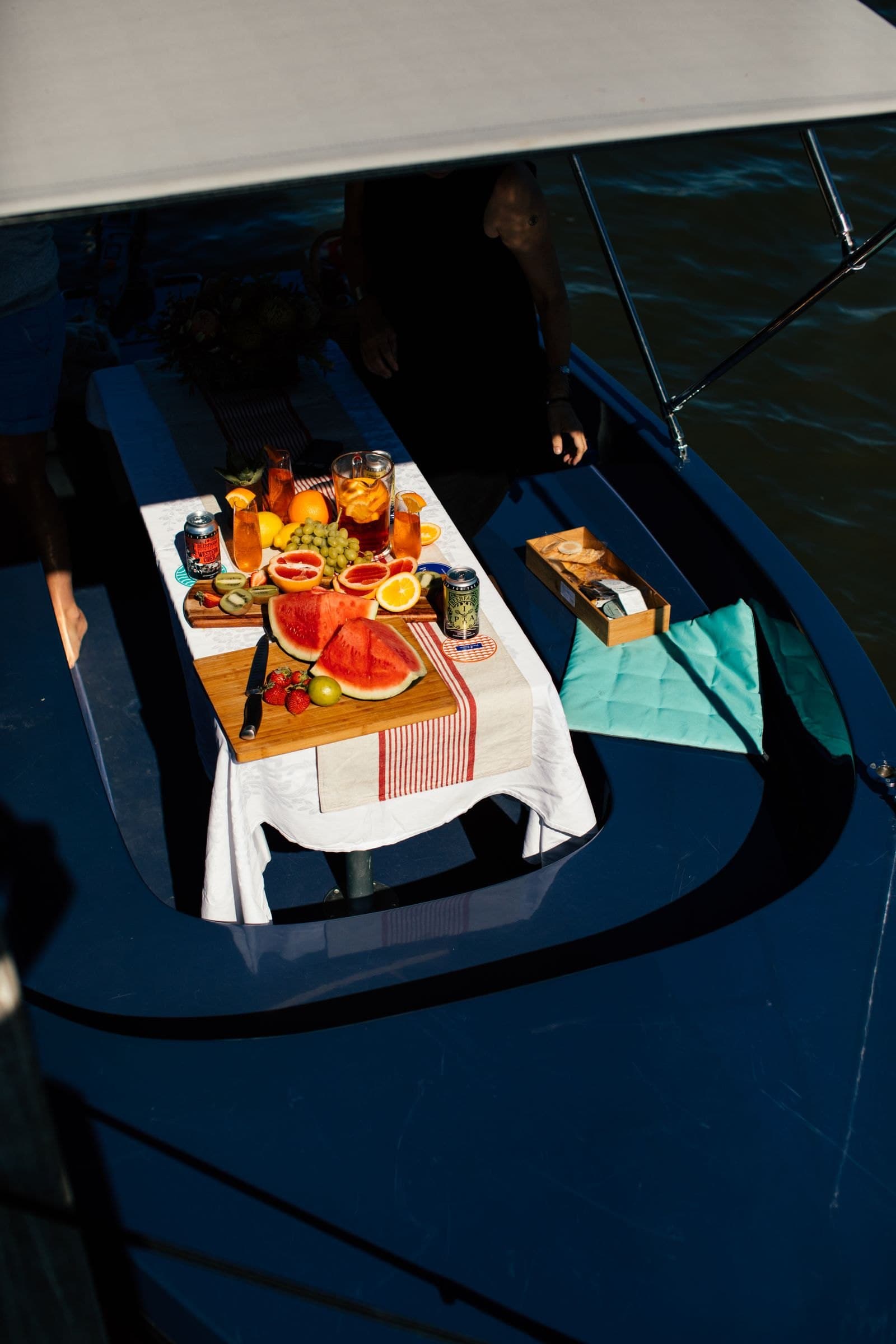
Working out quantities when you cannot run out for more
Short answer: use the same base formula as a party on shore, but add a thicker contingency margin and lock the list earlier. On shore, running short is an annoyance; on a boat, running short means losing a drink from the menu.
The base formula we use is two drinks per guest in the first hour, plus one drink for every hour after that. That calculation, along with the conversion table by headcount, is set out in full in our article on how to work out how much your guests will drink at an event; it is an industry estimate for planning purposes, not a scientifically sourced standard.
What changes on a boat is the contingency margin. On shore, ten to fifteen per cent is enough because there is always the option of buying more. On a boat, around twenty per cent is the level we find sensible, because the risk is not only that guests drink more than expected but also that glasses get dropped, that ice melts faster than planned in strong sun, and that the vessel returns later than scheduled. Nobody enjoys a party that runs forty minutes longer with a bar that has already run out of ice.
The structure of the menu should change too. A menu on board should be shorter than one on shore: four to six drinks is sensible, of which at least one is batched in advance to cover the peak, and there should always be at least one genuinely appealing non-alcoholic option rather than canned soft drinks. The detailed approach to building the menu framework is in our article on how to build a drinks menu for a party.
Drinking water is an item to be counted separately and counted generously. Out on the water, sunlight reflects more strongly than on shore and guests dehydrate faster than they themselves notice. A yacht bar without free drinking water placed somewhere easy to reach is a badly designed bar, however good the cocktail menu may be.
The takeaway for this section: keep the base formula from the on-shore party, but raise the contingency margin to around twenty per cent and shorten the menu — that is the whole of the adjustment needed when you move out onto the water.
| Item | Party on shore | Party on a yacht | Why it differs |
|---|---|---|---|
| Base formula | 2 drinks in the first hour + 1 drink for each hour after | Unchanged | Guest drinking behaviour does not change because the venue changes |
| Contingency margin | 10–15% | around 20% | No resupply; added risk of dropped glasses and a late return |
| Number of drinks on the menu | 6–10 drinks | 4–6 drinks | Narrow bar, slower movement, less room for ingredients |
| Batched drinks | Optional | At least 1 | The peak falls in the first ~20 minutes after the vessel leaves the pier |
| Drinking water | Available | Counted over and placed for self-service | Sunlight reflecting off the water dehydrates guests faster |
| Non-alcoholic drinks | 1–2 options | At least 2 genuinely appealing options | Guests who feel seasick or who will drive home need a decent option |
How many bartenders for how many guests
Short answer: staff a boat more heavily than you would on shore for the same headcount, because a narrow bar slows every movement and because nobody can be added mid-event. The safe approach is to take the equivalent package configuration used on shore and add one support position running trays.
The bottleneck on board is not the bartender's hands but the width of the bar. Two bartenders standing side by side at a 1.5m bar will knock into each other and work more slowly than one person alone; conversely, one person at a 3m bar cannot cover the peak. The correct decision order is therefore: measure the deck area first, choose the bar length, then fix the number of bartenders — not the other way round.
The peak on a yacht arrives earlier and harder than on shore. Guests board in groups, the vessel leaves the pier, and virtually everyone has a glass in hand within the first twenty minutes. The standard answer is to batch one or two drinks in advance for that first wave so bartenders keep their hands free for made-to-order drinks later — a principle covered in detail in our 30–90 minute cocktail hour checklist.
Our three standard staffing configurations correspond to the three packages Essential, Signature and Bespoke. On a yacht, the recommendation is to move up one tier compared with the equivalent headcount on shore, and always to have one person dedicated to the roaming trays for guests seated away from the bar.
One role often cut to save money, but which should not be cut, is the coordinator. On a boat, the coordinator is the only person holding the whole picture: where guests are bunching, how much ice is left, how long before the vessel turns back. Without that role, bartenders have to mix and guess at the same time — and on a boat a wrong guess cannot be fixed.
The takeaway for this section: measure the deck first, choose the bar second, fix the headcount last — doing it in the reverse order is the most common reason a bar on board seizes up.
| Guest numbers on board | Suitable bar length | Recommended staffing | Operating notes |
|---|---|---|---|
| Under 30 | 1.5m | 1 bartender | Enough if the menu is a tight 4–6 drinks and 1 of them is batched |
| 30–60 | 1.5m to 3m | 1 bartender + 1 support running trays | The support handles trays, ice and dirty glasses so the bartender never leaves the bar |
| 60–100 | 3m | 2 bartenders + 1 support | Split the roles: one mixes to order, one pours the batch during the opening peak |
| Over 100 | 3m or more, or 2 service points | 2 bartenders + 1 coordinator + 1 support | If the deck allows, split into 2 service points so the queue does not build in one place |
Seasickness is an operating constraint, not the guest's private problem
Short answer: a proportion of your guests will feel unwell to some degree, and that proportion is large enough that the service has to be designed around it — from where the bar sits, to the back-up drinks line, to what guests are told before they board.
The largest survey study on the subject collected data from 20,029 passengers on 114 voyages aboard 9 vessels; overall 7% of passengers reported vomiting at some point in the journey, 21% said they felt slightly unwell, 4% felt quite ill and a further 4% felt absolutely dreadful. That means close to a third of the people on board felt something unpleasant, even though only a small proportion reached the point of vomiting. Another peer-reviewed survey of European ferry passengers concluded that seasickness was the largest factor considered to cause discomfort, accounting for about 20% of all cases.
What matters for a bar lies in the final detail of that same 20,029-person study: the incidence of vomiting was associated with the use of anti-seasickness medication and with the consumption of alcoholic drinks. The strength of that finding has to be stated accurately: it is a recorded statistical association, not a causal conclusion. The medical advice is clearer — the travel handbook of the U.S. Centers for Disease Control and Prevention states that travellers should avoid alcohol and smoking because they increase motion sickness, while the UK's National Health Service advises not eating heavy or spicy meals and not drinking alcohol shortly before and during travel.
From a service point of view, three adjustments follow directly. First, the position of the bar: the UK's National Health Service advises sitting in the middle of the vessel and looking straight ahead at a fixed point such as the horizon, so placing the bar amidships, in the open air and with a view of the horizon, is far more comfortable than putting it in an enclosed compartment forward. Second, the menu needs a light line. Third, the pouring rhythm: a bartender with sea experience notices a guest starting to flag before the guest does, and switches to suggesting something non-alcoholic instead of pouring another drink.
There is one point where honesty beats salesmanship: the folk remedies are not agreed across sources. The UK's National Health Service lists ginger among the things worth trying, as capsules, biscuits or tea; whereas the handbook of the U.S. Centers for Disease Control and Prevention judges that the evidence for diets, supplements, vitamins, ginger and the like is weak and conflicting, and adds that laboratory testing has shown acupressure bands and similar approaches to be no more effective than placebo. We still prepare ginger-based drinks because guests like the flavour and because they sit lightly on the stomach, but we do not advertise them as medicine.
The takeaway for this section: assume in advance that some of your guests will feel unwell, and design the bar, the menu and the service rhythm around that assumption — that is the difference between a team used to parties on shore and a team used to parties on the water.
| Measure | Figure | Survey context | Source |
|---|---|---|---|
| Passengers who vomited at some point in the journey | 7% | 20,029 passengers, 114 voyages, 9 vessels | Lawther and Griffin, 1988 |
| Passengers who felt slightly unwell | 21% | same survey | Lawther and Griffin, 1988 |
| Passengers who felt quite ill | 4% | same survey | Lawther and Griffin, 1988 |
| Passengers who felt absolutely dreadful | 4% | same survey | Lawther and Griffin, 1988 |
| Share of seasickness among the causes of discomfort on ferries | about 20% | European ferry passengers | Bos et al. |
| Link between drinking alcohol and the incidence of vomiting | associated (not a causal conclusion) | same 20,029-person survey | Lawther and Griffin, 1988 |
Safety on the water: glassware, guests and the people operating the vessel
Short answer: three groups of risk need handling separately — broken glass on deck, guests drinking too much out on the water, and the absolute rule that alcoholic drinks never reach anyone operating the vessel. The third is a legal obligation, not a matter of courtesy.
Before the law, there is something many organisers do not know: alcohol is more dangerous on the water than on shore. The U.S. Coast Guard states plainly that the marine environment — motion, vibration, engine noise, sun, wind and spray — accelerates a drinker's impairment, and that data show that in alcohol-related boating fatalities, over half of the victims capsized their boat or fell overboard. The same source estimates that a boat operator with a blood alcohol concentration above 0.10% is more than ten times as likely to die in a boating accident as an operator with no alcohol, and states explicitly that passengers also face an increased risk of injury and death, particularly if they too are drinking.
Vietnam's Law on Prevention and Control of Alcohol Harms of 2019 strictly prohibits operating a means of transport with alcohol in the blood or breath, and adds a proactive duty: heads of transport business establishments and owners of means of transport are responsible for proactively taking measures to prevent, detect and stop persons operating transport vehicles from drinking alcohol immediately before and while participating in traffic. Applied in practice, that means the bar has to hold one immovable rule: no alcoholic drinks served to the crew, even when they are offered.
The same law also prohibits selling, supplying or promoting alcoholic drinks to anyone under 18 and prohibits anyone under 18 from drinking alcohol. On board, age control is harder than on shore because guests keep moving and the evening light is poor; the practical answer is to issue an identifying mark to the group cleared for alcoholic drinks right at the boarding point, rather than asking each guest's age at the bar every time. The law also strictly prohibits inciting, provoking, pressuring or forcing another person to drink alcohol — worth raising in advance with the organisers of corporate parties.
On glassware, one thing needs saying plainly because many articles online get it wrong: we searched the maritime regulations and found no provision banning glassware for passengers on board, and we could not find any Vietnamese document setting such a rule either. This article therefore does not claim that such a ban exists. Restricting glass on deck is industry practice, not a legal obligation.
What is interesting is that the logic behind that practice does have proper legal backing in a different framework — the framework covering venues with a body of water. The Model Aquatic Health Code of the U.S. Centers for Disease Control and Prevention provides that glass food and drink containers are prohibited in the patron areas of aquatic facilities. Florida's state regulations go as far as writing a rule specifically for bars beside the water: all food and drink must be served to patrons in containers not made of glass or of vitreous material that could injure patrons if broken, and bar staff must remove all metal rings, caps and tabs used to seal bottled drinks before handing them to patrons. These are United States standards, not Vietnamese rules — cited here to show the principle behind the practice, not to say you are obliged to follow them.
Applied to a deck, three factors combine to make a broken glass considerably more dangerous than on a dry indoor floor: the deck is wet, the floor slopes, and guests are often barefoot or in smooth-soled shoes. Our pragmatic choice is glass in areas with tables and dry flooring, polycarbonate on the open deck and near the gunwale, removing can tabs before serving, and always keeping a brush and dustpan ready at the bar. This is exactly the kind of detail that a team used to parties on boats has prepared in advance, and that a team not used to them discovers too late.
Finally there is the after-party piece many organisers forget: where guests go once they step ashore. If they drive themselves home, the ban on operating a means of transport with alcohol in the blood or breath applies in full on land. Arranging transport or agreeing a travel plan in advance is the organiser's job, and it should go into the plan at the same moment the docking time is fixed.
The takeaway for this section: on a boat, the most important safety line is not the one between the guest and the glass, but the one between the glass and the person steering the vessel.
| Risk group | How it shows up on board | How to handle it in preparation |
|---|---|---|
| Alcohol hits harder out on the water | Motion, vibration, engine noise, sun, wind and spray accelerate impairment compared with shore, according to the U.S. Coast Guard | Slower pouring rhythm than at a party on shore; always a non-alcoholic option alongside; drinking water placed for self-service |
| Crew operating the vessel drinking alcohol | Strictly prohibited; the owner of the vessel must proactively prevent it | A hard bar rule: no alcoholic drinks for the crew; written explicitly into the pre-party brief |
| Guests under 18 | Selling, supplying or promoting alcoholic drinks to anyone under 18 is prohibited | Issue an identifying mark at the boarding point instead of asking ages at the bar |
| Pressuring people to drink | Strictly prohibited under Law 44/2019/QH14 | Raise it in the brief with the organisers, especially for corporate parties |
| Broken glass on deck | Wet deck, sloping floor, barefoot guests. No maritime regulation bans glassware — this is industry practice, borrowing the logic from the U.S. rules for venues with a body of water | Polycarbonate glasses on the open deck; remove can tabs before serving; brush and dustpan kept ready at the bar |
| Seasickness | Guests abandon their glasses and do not want heavily sweet drinks | Have a cool, low-sugar line with ginger or a light sourness ready; self-service drinking water |
| Guests driving themselves home after coming ashore | Risk of breaching the rules on blood alcohol while participating in traffic | Fix the transport plan at the same time as the docking time |

The weather sets the plan: read the Beaufort scale before committing to an open deck
Short answer: fix the wind force at which the bar moves from the open deck into a sheltered space, and write that threshold into the contract. The Beaufort scale gives organisers, vessel owners and the bar team a shared way of talking about it, so nobody has to argue by feel.
The scale is not new: Admiral Francis Beaufort developed it in 1805 to help sailors estimate wind by visual observation; the scale starts at 0 and runs up to force 12, and it is still used today to estimate wind strength. The UK's Met Office describes it as an empirical measure used in shipping forecasts, based on observed sea conditions.
The part to read closely is the wave height that goes with each force. On the Met Office table, force 4 corresponds to waves of about 1 m, force 5 about 2 m, force 6 about 3 m and force 7 about 4 m. For a bar, force 5 is already the practical boundary: pouring accurately and shaking safely on an open deck is close to unworkable once the deck is moving through that range.
One caveat has to be stated clearly so the table is not misused: the Met Office notes that these wave figures apply to fully developed wind waves in the open sea. A sheltered bay such as Hạ Long, or a route running close to the coast, will see markedly lower waves at the same wind force. The table below is therefore for understanding the trend and agreeing a shared vocabulary; the final decision always rests with the captain and with the marine forecast for the specific area.
Writing it into the contract is straightforward: state the wind force at which the party changes plan, who makes the call, when the call is made, and what it means for the cost. Those four lines remove almost every argument on the morning of the party, when everyone is already tense.
The takeaway for this section: do not ask whether the weather will be nice on the day — fix in advance the wind force at which the bar leaves the open deck, and who has the authority to make the call.
| Beaufort force | Wind speed (knots) | Wind description | Typical open-sea waves | What it means for a bar on an open deck |
|---|---|---|---|---|
| 0–2 | under 7 | Calm to light breeze | 0 to 0.2 m | Ideal conditions; the bar operates normally |
| 3 | 7–10 | Gentle breeze | about 0.6 m | Normal; secure light items such as napkins and menus |
| 4 | 11–16 | Moderate breeze | about 1.0 m | Starting to get difficult; use lipped trays and low glasses, limit stemmed glassware |
| 5 | 17–21 | Fresh breeze | about 2.0 m | The practical boundary; move the bar into a sheltered area |
| 6 | 22–27 | Strong breeze | about 3.0 m | No service on the open deck; review the whole plan |
| 7 and above | 28 and above | Near gale and above | from 4.0 m | The question is no longer the bar but whether to put to sea at all |
How the cost is worked out: variables, not a single number
Short answer: the cost of a bar on a yacht is the base package for the size and duration, plus extended hours, plus the optional items chosen, plus a travel surcharge if the pier is outside the city, plus the elements specific to the vessel. We publish the starting price of each package on our price list, and the final figure is always confirmed after the survey.
The three current base packages start from 4.5 million VND for Essential, 12 million VND for Signature and 28 million VND for Bespoke. All of these prices include value added tax, mobile bar setup, ingredients covering spirits, mixers, ice, garnishes and fruit, glassware, bar tools and inner-city travel; out-of-province surcharges are charged per kilometre and stated transparently in the detailed quotation. These are reference figures we publish ourselves, not a survey of market prices.
What deserves attention when costing a yacht are the variables an on-shore party does not have. The vessel survey is a real line item that takes real time; a longer setup means a longer total staff mobilisation even when the service duration is unchanged; ice and water have to be brought in surplus; and if the pier is in Hạ Long, Nha Trang or Phú Quốc, travel falls into the out-of-province band rather than the inner-city one.
One common misunderstanding needs stating plainly: the cost of chartering the vessel is not part of the bartender quotation. That is a contract the client signs directly with the vessel operator, and it is usually several times larger than the bar. We quote for the drinks, the staff and the bar equipment; the vessel, the crew, passenger insurance and the voyage paperwork belong to the vessel owner.
If you need an estimating framework for the bar side before the survey, our article on mobile bar costs by size: 5m, 10m and 30m describes how the line items add up. For a party on board, use that framework and add the group of vessel-specific variables in the table below; the final figure still needs a vessel survey before it can be confirmed.
The takeaway for this section: do not go looking for a single standard price for a yacht party — work it out from the variables, because two vessels of the same capacity but with different deck layouts will produce two completely different bar configurations.
| Component | Content | Notes |
|---|---|---|
| Base package | Essential from 4.5 million VND · Signature from 12 million VND · Bespoke from 28 million VND | Starting prices published on the bartender.com.vn price list; inclusive of value added tax, setup, ingredients, glassware, tools and inner-city travel |
| Extended hours | 2,500,000 VND per hour | Includes the ingredients for the additional hour |
| Optional items | Bespoke signature drink 1,500,000 VND · branded coasters, 200 pieces, 1,200,000 VND · extended mocktail menu 800,000 VND · cocktail hour photography 3,500,000 VND · 15-minute flair show 5,000,000 VND | Chosen as needed; see the full list on the price list |
| Out-of-province surcharge | Charged per kilometre | Applies when the pier is outside the city, for example Hạ Long, Nha Trang or Phú Quốc |
| Variables specific to the vessel | Vessel survey · longer setup time · surplus ice and water · safe glassware for the open deck | Confirmed after the survey; no fixed rate, because it depends on the deck layout |
| Not included in the bar quotation | Vessel charter, crew, passenger insurance, voyage paperwork | Signed by the client directly with the vessel operator |
| Package | Suggested guest numbers | Staffing | Service duration | Bar | Menu |
|---|---|---|---|---|---|
| Essential | 30–60 guests | 1 standard bartender | 3 hours | 1.5m mobile bar | 6 classics |
| Signature | 80–200 guests | 2 senior bartenders with a supervisor | 4 hours | 3m branded mobile bar | 4 classics and 2 signatures |
| Bespoke | over 200 guests | 1 master, 2 seniors and a coordinator | 5 hours or more depending on the event | Custom-designed mobile bar | 6 or more classics and unlimited signatures |
Organising checklist by milestone
Short answer: split the work across four milestones — two weeks out for the survey and the configuration, three days out to lock the list, the day of the party for setup and counting, and after docking for the clear-down. The first milestone matters most, because it determines everything that follows.
The vessel survey is a step you cannot skip, even when the client has already sent photos and specifications. What you need to measure is not in the brochure: the width of the boarding route, the ceiling height where the bar will go, the position and the genuinely usable capacity of the power sockets, where there is shade for the ice chests, and where the waste can go. Those five measurements determine the bar length, the number of bartenders and the menu itself.
Three days out is the lock point. After that, any change to the headcount or the menu breaks the packing list, and on a boat the packing list is the one thing that cannot be revised once you have left the pier. For corporate parties where the guest list keeps moving until the last minute, the answer is to lock the menu and the bar configuration and let the contingency margin absorb the extra guests.
On the day, two people should hold two different sheets: one holds the stock count at the foot of the gangway, the other holds the running order on deck. Combining those two roles in one person is the most common organisational mistake, because the moment the stock needs counting is exactly the moment that person is running the schedule.
The post-docking phase is routinely underestimated. Clearing down on a boat is slower than on shore because everything has to come off by the same route it came on, while guests are disembarking at the same time. Build that time into the agreed vessel return time, or the extra cost lands somewhere nobody has planned for.
The takeaway for this section: if you can keep only one step of the whole checklist, keep the vessel survey — every other number comes out of it.
| Milestone | What must be completed | Who owns it |
|---|---|---|
| From 14 days out | Vessel survey: measure the boarding route, ceiling height, sockets and capacity, shade for the ice chests, waste storage. Fix the bar length and the number of bartenders. Fix the wind-force threshold for changing the plan and who makes the call | Bar team and vessel owner |
| From 7 days out | Fix the menu against the headcount and duration. Fix the list of non-alcoholic drinks. Agree the rule of no alcoholic drinks for the crew | Organisers and bar team |
| 3 days out | Lock the headcount and the menu. Build the packing list. Order ice and water at the calculated quantity plus a contingency margin of around 20% | Bar team |
| Morning of the party | First count at the store. Second count at the foot of the gangway. Build and secure the bar before guests board. Final check of the marine forecast | Coordinator |
| During the party | Check remaining ice and clean glassware every 30 minutes. Keep drinking water available for self-service. Clear broken glass the moment it happens | Bartenders and support |
| After docking | Collect waste into sealed bags to take back ashore. Break down the bar by the same route it came on. Inventory the glassware and tools | The whole team |
In closing
A bartender party on a yacht is not difficult because of mixing technique; it is difficult because the vessel takes away three things every bar on shore takes for granted: a floor that stays still, floor area that can flex, and the ability to buy more. Compensate for those three with a thorough survey, a correctly sized bar, a shorter menu and a thicker contingency margin, and most of the work is already done.
The rest is discipline: ice managed as food, the wind-force threshold fixed in writing rather than by feel, and the rule of no alcoholic drinks for anyone operating the vessel held absolutely.
If you are planning a party on the water, start with the survey rather than with the menu. You can look at our three service packages, check the price list and the optional items, see the events we have delivered, or send us a quotation request with your date, pier, guest numbers and expected duration. If you would rather talk it through before you have all the details, contacting our advisory team directly works just as well.
The takeaway for the whole article: on a yacht, the quality of a bar is decided before the vessel leaves the pier — by the deck survey and by the stock count sheet at the foot of the gangway, not by the skill of the person standing behind the bar.
Note: alcoholic drinks are served only to guests aged 18 and over. Please drink responsibly, and do not operate any means of transport after drinking alcohol.
FAQ
At how many guests does a boat need a 3m mobile bar instead of a 1.5m one?
The practical threshold is around 60 guests, but that number only holds if the deck has the space. A 3m bar plus the working space behind it takes up roughly four to five square metres, the equivalent of eight to ten standing guests. If the deck does not have that area to spare, the better option is to keep the 1.5m bar and add one person running roaming trays.
Are plastic glasses mandatory on a yacht?
It is not mandatory. We searched the maritime regulations and found no provision banning glassware for passengers on board, and we could not find any Vietnamese document setting such a rule either — so this is a risk decision rather than a legal obligation. The pragmatic approach is glass in areas with tables and dry flooring, and polycarbonate on the open deck and near the gunwale. The principle is borrowed from the U.S. rules for venues with a body of water, where glass containers are prohibited in patron areas.
Can the captain and the crew drink with the guests?
No. Vietnam's Law on Prevention and Control of Alcohol Harms strictly prohibits operating a means of transport with alcohol in the blood or breath, and at the same time requires owners of means of transport to proactively prevent the people operating them from drinking alcohol before and during travel. The bar needs to make this a hard rule right from the brief.
How much surplus should you prepare for a party on board, in per cent?
Around twenty per cent, thicker than the ten to fifteen per cent normally used for a party on shore. This is an operating estimate, not a scientific standard; the reason for raising the margin is that there is no option to buy more on a boat, and that ice melts faster than planned in strong sun.
Is the cost of chartering the vessel included in the bartender quotation?
No. Our quotation covers the staff, the bar equipment and the drink ingredients. The vessel charter, the crew, passenger insurance and the voyage paperwork are contracted by the client directly with the vessel operator.
At what wind strength does the plan have to change?
Fix a specific wind force in the contract in advance. On the Met Office Beaufort table, force 5 corresponds to open-sea waves of about 2 m, and that is the practical boundary for serving on an open deck; a sheltered bay will be gentler at the same wind force. The final decision always rests with the captain and with the marine forecast for the area.
How many guests will get seasick, and what should the bar prepare?
In a survey of 20,029 passengers on passenger vessels, 7% reported vomiting at some point in the journey, 21% felt slightly unwell, 4% felt quite ill and 4% felt absolutely dreadful. The figures depend heavily on how rough the particular voyage is, so treat them as a planning benchmark rather than a forecast. On the bar side, the three things to do are to place the bar amidships where the horizon is still visible, to have a cool, low-sugar drinks line ready, and to keep drinking water where guests can help themselves.
Should you prepare ginger drinks to counter seasickness?
Preparing them is a good idea, but do not advertise them as medicine. The UK's National Health Service lists ginger among the things worth trying, while the handbook of the U.S. Centers for Disease Control and Prevention assesses the evidence for ginger and similar supplements as weak and conflicting. The two sources do not agree, so we present it exactly that way.
How far in advance should you book?
At least two weeks, because the vessel survey has to take place before the bar configuration and the menu can be fixed. For peak season or an out-of-province pier, booking earlier makes it easier to secure the date and the right team.
Sources
World Health Organization, Guide to ship sanitation, third edition, Geneva, 2011 — full-text PDF: https://iris.who.int/server/api/core/bitstreams/aadd4839-673b-4250-b6a2-2d6b7f55b7de/content. Sourcing note: the landing page on who.int is still live but the PDF link on that page is broken, and the older bitstream paths return a page shell instead of the file; the actual PDF was obtained through the data interface of the IRIS repository at the path above, and was verified against the cover page and the direct quotations.
Law No. 44/2019/QH14 — Law on Prevention and Control of Alcohol Harms, passed by the National Assembly on 14 June 2019, in force from 1 January 2020. Document page: https://vanban.chinhphu.vn/default.aspx?pageid=27160&docid=197311. Original Official Gazette PDF: https://datafiles.chinhphu.vn/cpp/files/vbpq/2019/07/44.signed.pdf (a scan with no text layer, so it was rendered to images and read page by page to extract Article 5 and Article 21).
QCVN 72:2025/BGTVT — national technical regulation on the classification and construction of inland waterway vessels, issued with Circular 02/2025/TT-BGTVT of 8 January 2025 by the Ministry of Transport, in force from 1 August 2025 (replacing QCVN 72:2013/BGTVT). Official gazette page: https://congbao.chinhphu.vn/van-ban/thong-tu-so-02-2025-tt-bgtvt-43936/54419.htm. Digitally signed gazette PDF, Part 5 (fire prevention, detection and fighting): https://congbaocdn.chinhphu.vn/CongBaoCP/VanBan/2025/1/43936/54434-1-2025219-22002-2025-tt-bgtvt.pdf. Digitally signed gazette PDF, Part 10 (safety equipment): https://congbaocdn.chinhphu.vn/CongBaoCP/VanBan/2025/1/43936/54440-1-2025223-22402-2025-tt-bgtvt.pdf.
U.S. Food and Drug Administration, Handling food safely while eating outdoors: https://www.fda.gov/food/buy-store-serve-safe-food/handling-food-safely-while-eating-outdoors. Accessed 4 August 2026.
Vietnam's National Statistics Office, Statistical Yearbook of Vietnam 2024, Table 14 — Monthly mean air temperature in 2024 at selected observation stations: https://www.nso.gov.vn/wp-content/uploads/2025/06/NGTK-Cuc-TK-2024_BQ.pdf. The figures for the Bãi Cháy and Nha Trang stations are taken directly from that table.
Lawther A. and Griffin M.J., A survey of the occurrence of motion sickness amongst passengers at sea, Aviation, Space, and Environmental Medicine, 1988 — record and abstract: https://europepmc.org/article/MED/3390095 (full abstract read through the Europe PMC data interface).
Bos J.E. et al., a study on the assessment of passenger discomfort on board ships — full-text PDF in the publications repository of the Institute of Sound and Vibration Research, University of Southampton: https://resource.isvr.soton.ac.uk/staff/pubs/PubPDFs/Pub8465.pdf.
Centers for Disease Control and Prevention (United States), CDC Yellow Book — Motion Sickness chapter: https://www.ncbi.nlm.nih.gov/books/NBK620959/. Accessed 4 August 2026.
National Health Service (United Kingdom), Motion sickness: https://www.nhs.uk/conditions/motion-sickness/. Accessed 4 August 2026.
U.S. Coast Guard, Boating Under the Influence Initiatives: https://uscgboating.org/recreational-boaters/boating-under-the-influence.php. Accessed 4 August 2026.
Model Aquatic Health Code (the model code of the U.S. Centers for Disease Control and Prevention), section 5.6.9.2.1 Containers: https://cmahc.org/mahc_sections/1608. Sourcing note: every PDF of this document on cdc.gov returns 403 to automated access, so it is cited from the site of the Council for the Model Aquatic Health Code — the official partner organisation in the process of updating the code.
Florida Administrative Code, Chapter 64E-9 Public Swimming Pools and Bathing Places, section 64E-9.004 — the version published by the Florida Department of Health: https://www.floridahealth.gov/wp-content/uploads/2025/08/64e-9faceff7-20-2016a004eff6-11-2023.doc.
Note on glassware on board: we searched the maritime regulations and found no provision banning glassware for passengers, nor any corresponding Vietnamese rule. This article therefore presents the restriction of glass as industry practice, and cites the U.S. rules for venues with a body of water only to explain the principle — not to suggest that it is a legal obligation in Vietnam.
World Health Organization Europe, No level of alcohol consumption is safe for our health, 4 January 2023: https://www.who.int/europe/news/item/04-01-2023-no-level-of-alcohol-consumption-is-safe-for-our-health.
Met Office (United Kingdom), Beaufort wind force scale — the table of wind forces and wave heights used in shipping forecasts: https://www.metoffice.gov.uk/weather/guides/coast-and-sea/beaufort-scale. Accessed 4 August 2026.
NOAA National Weather Service, Beaufort Wind Scale — history and description of the scale: https://www.weather.gov/mfl/beaufort. Accessed 4 August 2026.
Prices and package configurations are taken from our own official pages: https://bartender.com.vn/en/pricing and https://bartender.com.vn/en/services. Accessed 4 August 2026.
Note on the figures that have NO source: the staffing levels by guest numbers, the contingency margin of around 20%, the number of drinks on the menu and the floor area a bar occupies are operating estimates used for planning by the bartender.com.vn team, not data published by any organisation. We were also unable to find any per-guest ice quantity published by a government body, an industry association or a technical standard, so this article does not give such a figure. The latent heat of fusion of water ice of about 334 joules per gram is a physics textbook constant. The temperature thresholds in this article are always stated together with the body that issued them, because each body sets a different figure and they must not be mixed.
Planning an event?
Get a free quote
Tell us about your event and our team will recommend the right package and send a detailed quote — no commitment.