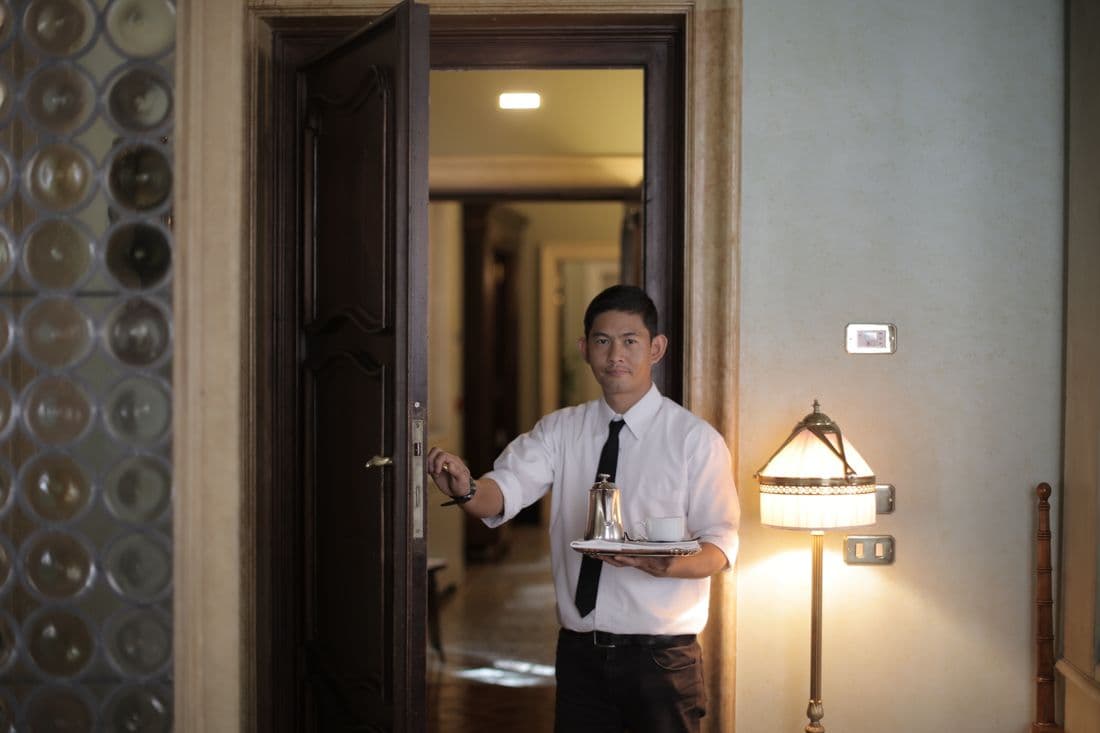
Restaurant staff serving international guests at the table

English for Restaurant Service

English for Restaurant Service

Face-to-face communication with international guests: bookings, menu advice, bar service and complaint handling.

35hours
4weeks
20hTheory
14hPractice
1hTest

A 35-hour programme over 4 weeks: 10 situation-based units plus a final test. Learners build the language reflexes to greet guests, take orders, present wine and resolve issues in professional English.

Tuition2.500.000₫ / learner

Training objectives

  • Provide the vocabulary, professional terminology and applied grammar used in restaurants and bars.
  • Understand the English terms for tools, glassware, menus, wine styles and the six classic base spirits.
  • Master the internationally standard service phrases.

Learning outcomes

  • Respond fluently in face-to-face conversation with international guests.
  • Greet guests, advise on the menu, and take and repeat orders accurately in English.
  • Present, open and pour wine at the table; resolve service-area issues in English.
  • Maintain a professional, confident manner, manage emotions and own the quality of communication.

Roles after the course

  • Restaurant and hotel staff serving international guests
  • Self-employment or a start-up in the restaurant and hotel sector

Programme content

Unit 1

Taking phone calls

02 hours
Theory 01hPractice 01h
Objectives
  • Use the vocabulary for answering telephone calls.
  • Use the target structures (Can/Could, I’d like to…).
  • Build a courteous, confident and professional communication habit.
Content
  • Vocabulary
  • Structures to practise
  • Skills
  • Exercises
Unit 2

Giving information

02 hours
Theory 01hPractice 01h
Objectives
  • Use the vocabulary for describing the location and facilities of a restaurant or hotel.
  • Use the present simple of “be”.
Content
  • Vocabulary
  • Structures to practise
  • Skills
  • Exercises
Unit 3

Introduction to wines and food pairing

03 hours
Theory 02hPractice 01h
Objectives
  • Learn the terms for wine styles (red, white, rosé, sparkling) and basic tasting descriptors (dry, sweet, full-bodied, fruity).
  • Advise on food-and-wine pairing from the menu in English.
Content
  • Vocabulary
  • Structures to practise
  • Skills
  • Exercises
Unit 4

Bar operations & mixology English

04 hours
Theory 02hPractice 02h
Objectives
  • Master the English terminology for bar tools, ingredients and core mixing methods.
  • Present the menu, describe drink flavours and run the service sequence confidently in professional English.
Content
  • Vocabulary
  • Structures to practise
  • Skills
  • Exercises
Unit 5

Taking restaurant bookings

05 hours
Theory 03hPractice 02h
Objectives
  • Use the vocabulary for gathering information when taking a booking.
  • Use adverbs of frequency.
Content
  • Vocabulary
  • Structures to practise
  • Skills
  • Exercises
Unit 6

Handling guest complaints

03 hours
Theory 02hPractice 01h
Objectives
  • Explain and decline a guest request politely.
  • Use present simple short forms.
Content
  • Vocabulary
  • Structures to practise
  • Skills
  • Exercises
Unit 7

Receiving guests

04 hours
Theory 02hPractice 02h
Objectives
  • Use the vocabulary for greeting and receiving guests at a restaurant or hotel.
  • Use possessive adjectives.
Content
  • Vocabulary
  • Structures to practise
  • Skills
  • Exercises
Unit 8

Serving in the bar

05 hours
Theory 03hPractice 02h
Objectives
  • Use the vocabulary for offering and asking what a guest would like at the bar.
  • Use requests and offers (Can/Could, Shall…).
Content
  • Vocabulary
  • Structures to practise
  • Skills
  • Exercises
Unit 9

Instructions

03 hours
Theory 02hPractice 01h
Objectives
  • Use the vocabulary for explaining the drinks a guest has ordered.
  • Give instructions using sequence markers (first/next/then/finally…).
Content
  • Vocabulary
  • Structures to practise
  • Skills
  • Exercises
Unit 10

Taking a food order

03 hours
Theory 02hPractice 01h
Objectives
  • Use the vocabulary for taking a food order (starters, mains, desserts…).
  • Use guest-request forms and articles (a/an/the).
Content
  • Vocabulary
  • Structures to practise
  • Skills
  • Exercises
Final test

End-of-course examination

01 hour
Objectives
  • Assess listening, speaking and situation-handling ability in professional English.
Content
  • End-of-course examination

Admission requirements

Learners aged 15 and above, literate (able to read and write), and in good health.

Certificate issued by

Nhan Dao Vocational SchoolHo Chi Minh City Department of Education and Training

Assessment & certification

Continuous assessment (regular + periodic tests) combined with a final examination on a 10-point scale. A score of 5.0 or above qualifies the learner for course completion and an elementary vocational certificate.

Tuition effective from 1 August 2026 per Notice TB-153 dated 23 July 2026 issued by Nhan Dao Vocational School.

General training objectives

  • Train practitioners for the restaurant and hotel service trade with occupational competence matching the training level.
  • Develop ethics, health and professional responsibility.
  • Enable learners to find work, create their own work, or progress to a higher qualification after completion.

Key areas of emphasis

  • Industry-specific English vocabulary
  • Communication in the workplace
  • Reading restaurant and hotel menus
  • Serving and communicating with guests in English

Completion requirements

All required assessment scores completed; a final examination score of 5.0 or above; and not subject to criminal prosecution at the time of the final examination.

Reference materials

  • Donald Adamson (1992), Basic English for Hotel Staff: Be Our Guest, Prentice Hall International (UK) Ltd.
  • Trish Stott and Roger Holt (1991), English for Tourism: First Class, Oxford University Press.
  • Christopher St. J Yates (1992), English in Tourism: Check-in, Prentice Hall International (UK) Ltd.
  • Rod Revell & Chris Stott (1982), Five star English for the hotel and tourist industry, Oxford University Press.
  • Lê Huy Lâm & Phạm Văn Thuận (2001), Spoken English for Hotel Staff, NXB TP. Hồ Chí Minh.
  • Leo Jones (1998), English for the travel and tourism industry: Welcome, Cambridge University Press.

Ahead of regulation

Why a vocational certificate matters

01

Rules are tightening

The 2025 Employment Law (in force 1 Jan 2026) requires a national vocational skills certificate for safety-sensitive occupations for the first time — the list may widen over time.

02

Star-rated hotels

Under TCVN 4391:2015, a food-and-beverage or bar supervisor needs an elementary, intermediate or college vocational qualification; holders of other certificates must complete a conversion course.

03

Hiring advantage

Holding a certificate early makes applications and promotion easier — especially for people already working who need to formalise their skills.

Beyond the certificate

A structured route to employment

  • Digital skills profileskills profile plus practice and performance video.
  • Hiring networkbars, cafés, restaurants and hotels across Bartender.com.vn.
  • A real competition stagereferral to Saigon Bartender Connect; top learners get hiring priority.
  • Post-graduation trackingwe record the employment rate to measure the programme.
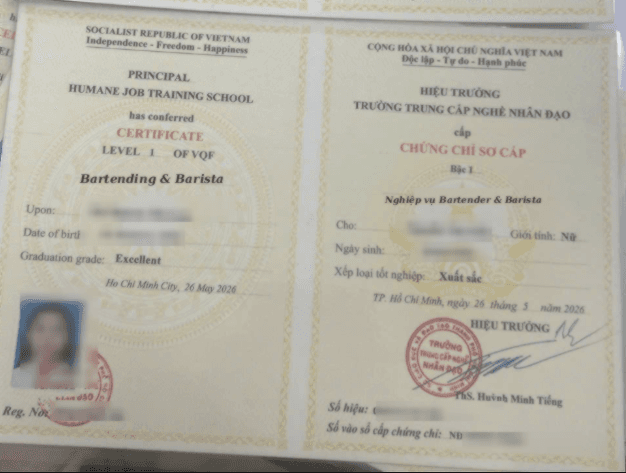
Sample bilingual elementary vocational certificate issued by Nhan Dao Vocational School
Sample elementary certificate · Vietnamese – English

Frequently asked questions

How much does English for Restaurant Service cost and when does the price apply?

2.500.000₫ per learner. Tuition effective from 1 August 2026 per Notice TB-153 dated 23 July 2026 issued by Nhan Dao Vocational School.

How long is the programme?

35 hours over 4 weeks — 20h theory, 14h practice and 1h assessment, across 11 lessons.

Who can enrol?

Learners aged 15 and above, literate (able to read and write), and in good health.

What do I receive on completion?

An elementary vocational certificate issued by Nhan Dao Vocational School (Ho Chi Minh City Department of Education and Training). Continuous assessment (regular + periodic tests) combined with a final examination on a 10-point scale. A score of 5.0 or above qualifies the learner for course completion and an elementary vocational certificate.

Enrol in this programme

Leave your details — our admissions team will call you back to confirm the schedule, tuition and paperwork.

Zalo