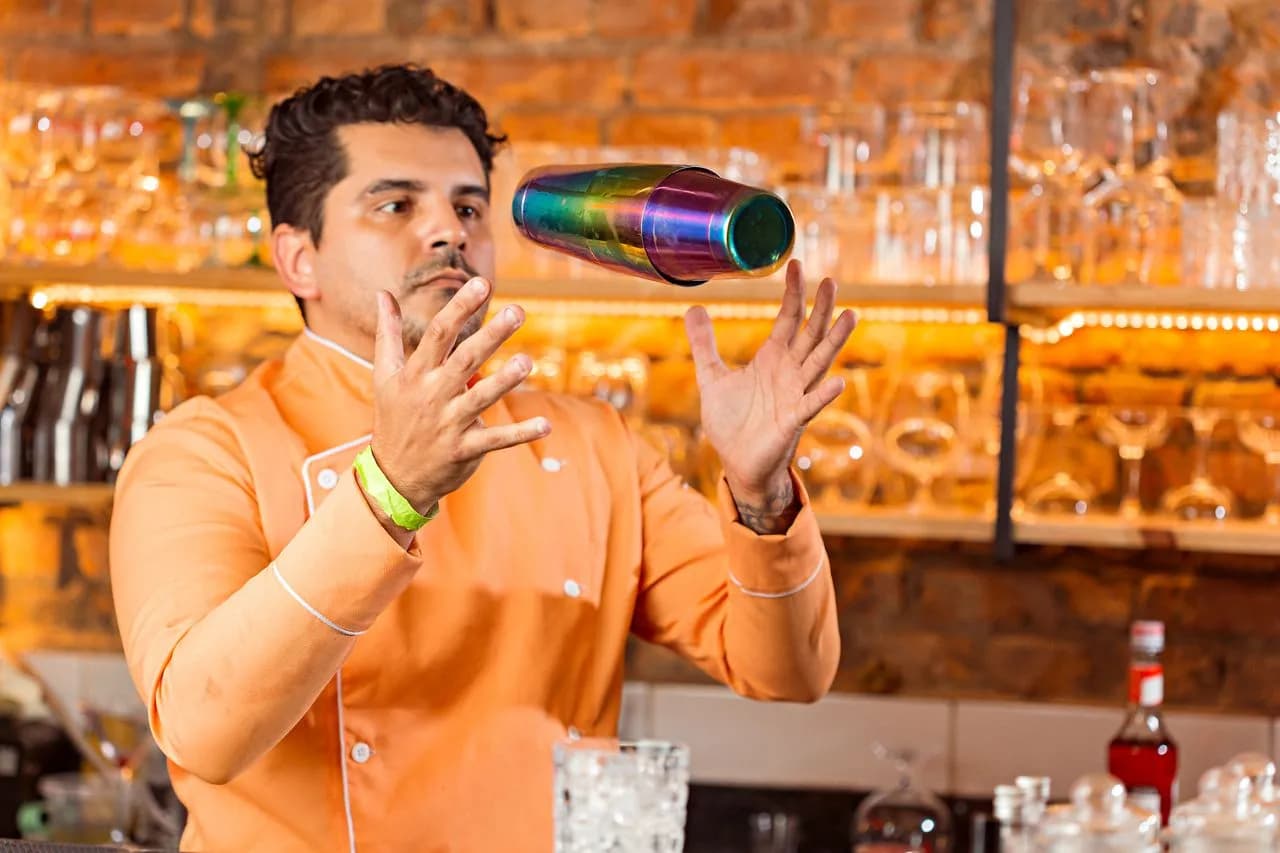
The craft and art of performing behind the bar — from glass polishing to shaker-and-bottle combinations.
In short
A 60-hour programme over 5 weeks with 52 hours of practice. Learners identify and select the right performance tools, master each basic move, then combine them into a complete routine.
Last updated: 28/07/2026
Bartender Showmanship
Bartender Showmanship
The craft and art of performing behind the bar — from glass polishing to shaker-and-bottle combinations.
60hours
5weeks
6hTheory
52hPractice
2hTest
A 60-hour programme over 5 weeks with 52 hours of practice. Learners identify and select the right performance tools, master each basic move, then combine them into a complete routine.
Name the types of bartender performance and the requirements attached to each.
Explain the basic performance moves for each mixing tool.
Learning outcomes
Identify and select the tools used in performance.
Execute the basic performance moves.
Deliver a routine combining several basic moves.
Build persistence and creativity, and a genuine passion for the craft.
Roles after the course
Bar staff at restaurants, hotels and lounges with a performance element
Event and brand-activation bartender
Programme content
Lesson 1
Introduction to bartender performance craft and art
08 hours
Theory 04hPractice 04h
Objectives
Explain the concept, characteristics and requirements of bartender performance.
Identify the tools used for bartender performance.
Appreciate why performance matters to bar business.
Content
Overview of bartender performance
The art of bartender performance
Lesson 2
Bartender performance technique
37 hours
Theory 04hPractice 31hTest 02h
Objectives
Explain performance styles and the technique for handling each tool.
Handle tools flexibly and execute the basic performance moves fluently while mixing.
Build persistence and creativity, and self-correct mistakes at work.
Content
Glass-polishing technique
Performing with jigger and pourer
Performing with ice cubes
Performing with the bar spoon
Performing with the shaker
Performing with the bottle
Combining shaker and bottle
Combining two bottles
Admission requirements
Learners aged 15 and above, literate (able to read and write), and in good health.
Certificate issued by
Nhan Dao Vocational School — Ho Chi Minh City Department of Education and Training
Assessment & certification
Continuous assessment (regular + periodic tests) combined with a final examination on a 10-point scale. A score of 5.0 or above qualifies the learner for course completion and an elementary vocational certificate.
Tuition effective from 18 August 2026 per Notice TB-170 dated 18 August 2026 issued by Nhan Dao Vocational School.
General training objectives
Train practitioners for the restaurant and hotel service trade with occupational competence matching the training level.
Develop ethics, health and professional responsibility.
Enable learners to find work, create their own work, or progress to a higher qualification after completion.
Key areas of emphasis
Core techniques
Hygiene and safety
Completion requirements
All required assessment scores completed; a final examination score of 5.0 or above; and not subject to criminal prosecution at the time of the final examination.
Reference materials
DeGroff, D. (2020). The craft of the cocktail. Clarkson Potter.
Difford, S. (2022). Difford's guide to cocktails: 3000 recipes. Odd Firm of Sin.
Sturman, M. (2018). The art of flair bartending. BarMedia Publishing.
International Bartenders Association. (2023). IBA official cocktail list.
World Flair Association. (2024). Flair bartending professional standards and competition guidelines.
Trường Cao đẳng Du lịch và Công thương. (2022). Giáo trình Kỹ thuật trình diễn Bartender.
Ahead of regulation
Why a vocational certificate matters
01
Rules are tightening
The 2025 Employment Law (in force 1 Jan 2026) requires a national vocational skills certificate for safety-sensitive occupations for the first time — the list may widen over time.
02
Star-rated hotels
Under TCVN 4391:2015, a food-and-beverage or bar supervisor needs an elementary, intermediate or college vocational qualification; holders of other certificates must complete a conversion course.
03
Hiring advantage
Holding a certificate early makes applications and promotion easier — especially for people already working who need to formalise their skills.
Beyond the certificate
A structured route to employment
Digital skills profile — skills profile plus practice and performance video.
Hiring network — bars, cafés, restaurants and hotels across Bartender.com.vn.
A real competition stage — referral to Saigon Bartender Connect; top learners get hiring priority.
Post-graduation tracking — we record the employment rate to measure the programme.
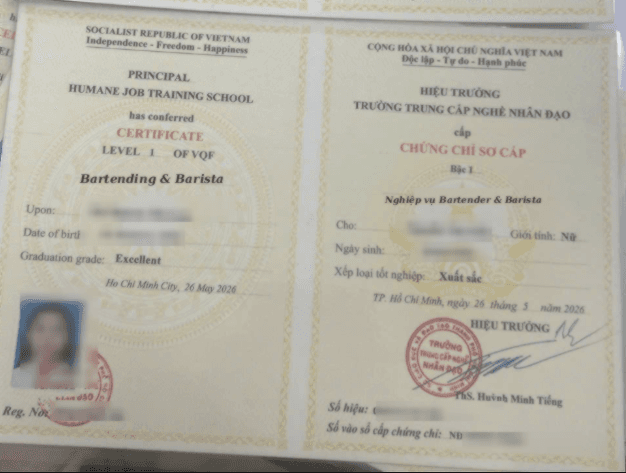
Sample elementary certificate · Vietnamese – English
Frequently asked questions
How much does Bartender Showmanship cost and when does the price apply?
4.000.000₫ per learner. Tuition effective from 18 August 2026 per Notice TB-170 dated 18 August 2026 issued by Nhan Dao Vocational School.
How long is the programme?
60 hours over 5 weeks — 6h theory, 52h practice and 2h assessment, across 2 lessons.
Who can enrol?
Learners aged 15 and above, literate (able to read and write), and in good health.
What do I receive on completion?
An elementary vocational certificate issued by Nhan Dao Vocational School (Ho Chi Minh City Department of Education and Training). Continuous assessment (regular + periodic tests) combined with a final examination on a 10-point scale. A score of 5.0 or above qualifies the learner for course completion and an elementary vocational certificate.
In one line: Bartender Showmanship is a 60-hour programme over 5 weeks (6h theory, 52h practice, 2h assessment), tuition 4.000.000₫ / learner, awarding an elementary vocational certificate from Nhan Dao Vocational School; tuition applies from 18 August 2026.