The bartending craft
Showmanship vs Flair Bartending: What's the Difference?
Bartender.com.vn · 21/07/2026 · 11 min read
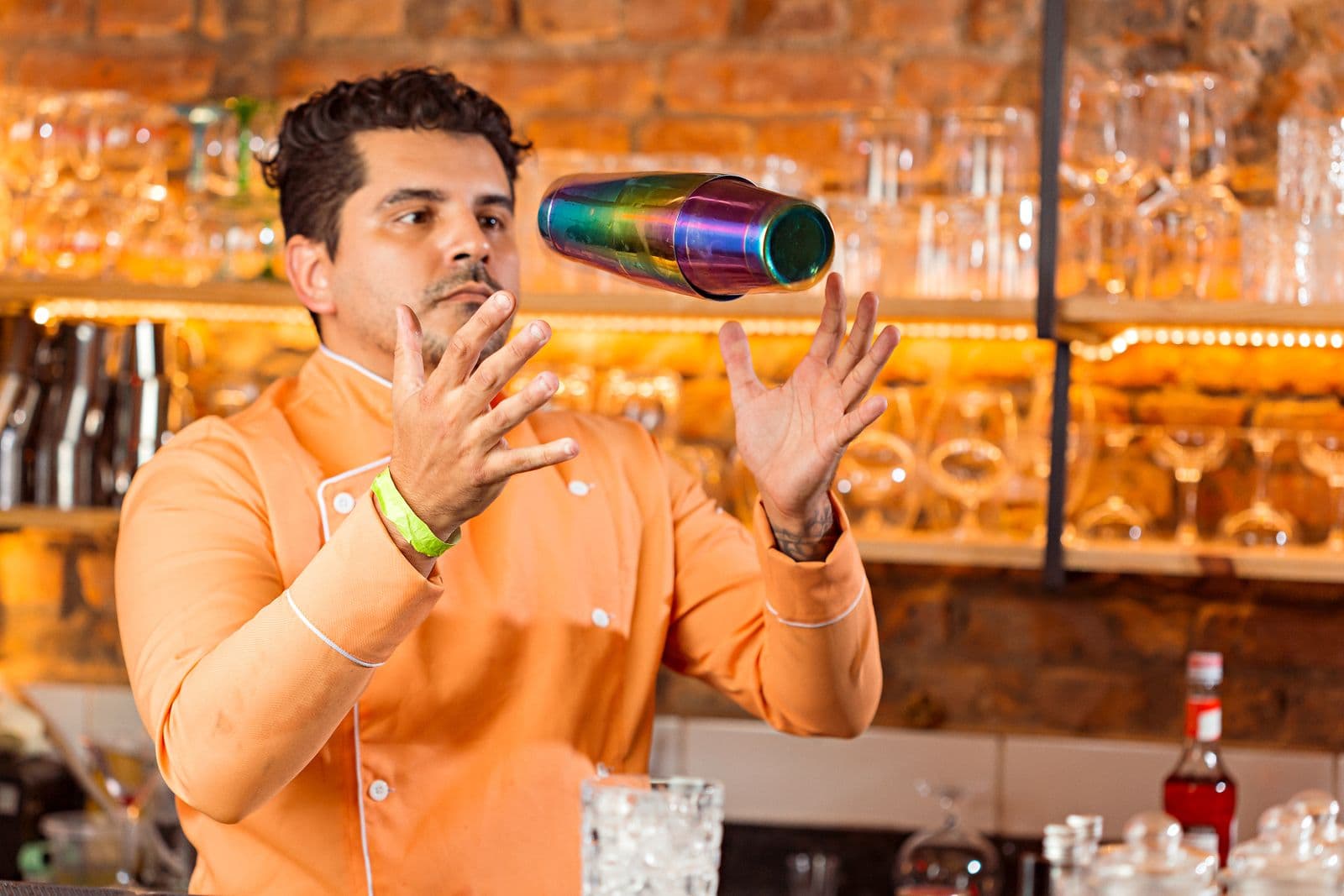
Flair is performance technique with bottles and shakers; showmanship is the art of staging the whole bar experience — flair is just one tool within it. An in-depth comparison: working vs exhibition vs craft flair, nearly 170 years of history from Jerry Thomas to the movie Cocktail, IBA scoring and how to pick a style for your venue.
Showmanship and flair: two schools, one root
Flair bartending is a style of bartending that adds semi-acrobatic moves — bottle tosses, shaker spins, long pours — to entertain and impress guests while a drink is being made (as defined by The Oxford Companion to Spirits & Cocktails). Showmanship is broader: it is the whole art of staging the bar experience — how you greet a guest, tell a story, perform preparation rituals and pace every movement — of which flair is just one tool among many.
In short: every great flair bartender is practising showmanship, but a bartender with great showmanship never needs to throw a bottle. A speakeasy bartender can win a guest over with nothing more than an unhurried stirring ritual and the story behind a mocktail.
Interestingly, both schools share one founding father: Jerry Thomas — the 19th-century "father of American bartending" — who was both the first performer of a flaming drink and a master of personal branding. This article breaks down every difference: definitions, history, technique, context and the training-to-competition path.
| Criteria | Flair bartending | Showmanship |
|---|---|---|
| Essence | Performance technique with bottles, shakers, tools | The art of staging the entire guest experience |
| Scope | A subset of showmanship | Umbrella: interaction, ritual, storytelling, flair |
| Demands | Drilled moves, object control | Reading guests, scripting, pacing, finesse |
| Where it shines | Clubs, beach bars, events, competition stages | Every venue type — including quiet bars |
What flair bartending is: working, exhibition and craft flair
Working flair is flair on shift: stylish moves performed with the very bottles being used for service, at random fill levels, under one golden rule — it must not noticeably slow service. The drink remains the point; the moves simply add visual panache to work that has to happen anyway.
Exhibition flair is a pre-choreographed routine: bottles are typically set below roughly 60ml specifically for juggling, and sequences are long and difficult. In competition, exhibition flair is judged less on the quality of the cocktail than on technical ability, precision, showmanship and difficulty — closer to sport-circus performance than to service.
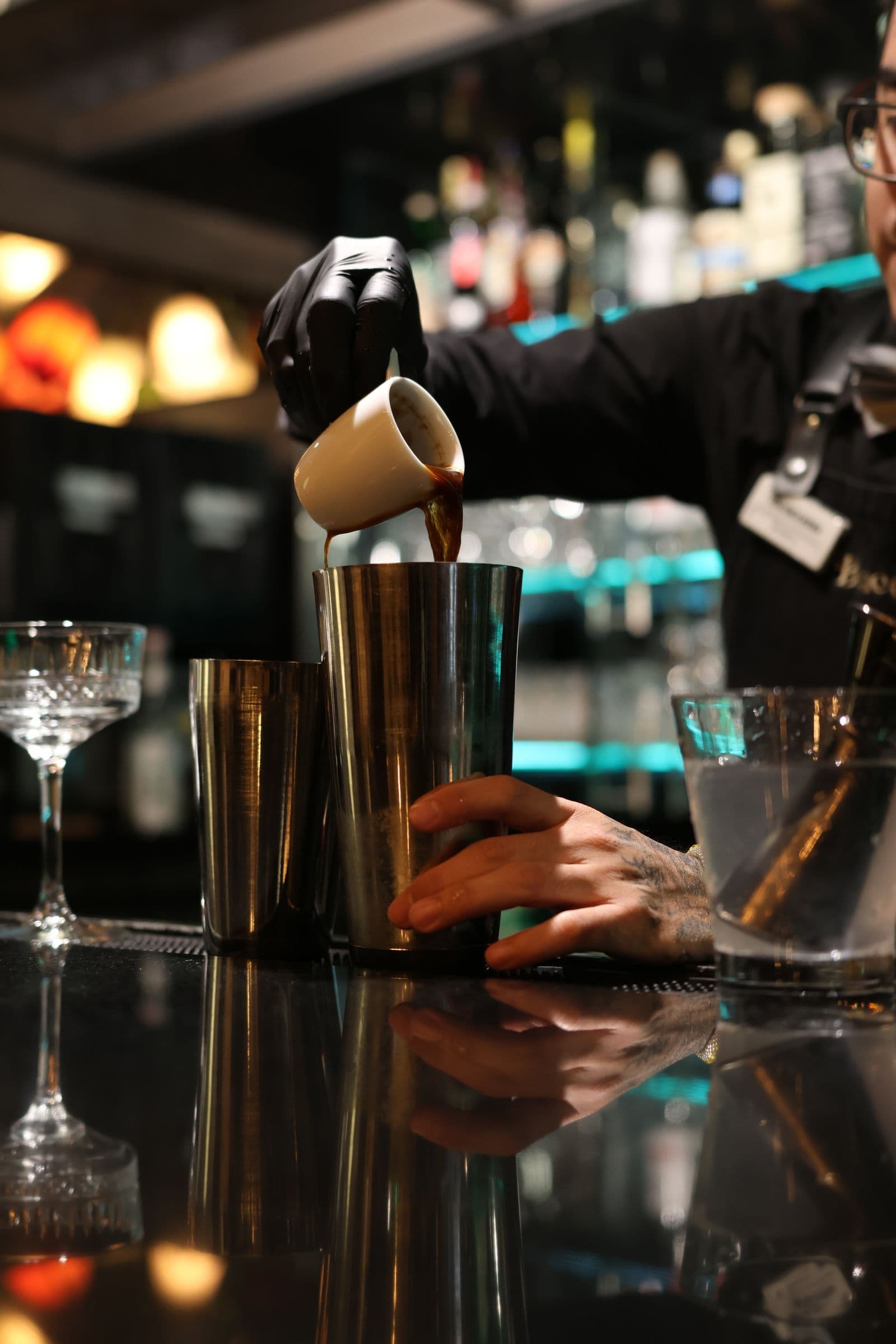
The European Bartender School adds a third branch: craft flair — bottles are rarely thrown; the focus is the smoothness of small gestures: how ice drops into the shaker, a jigger rolling across the fingers, a bar spoon spinning. This is the most beautiful overlap between flair and showmanship: service technique elevated into body language without sacrificing speed.
For flair fundamentals from scratch (detailed history, practice gear, safety), read "What is flair bartending" in this Library — this article focuses on the comparison.
Showmanship: when the whole bar is a stage
Showmanship has no standalone dictionary entry the way flair does — but the industry defines it by scoring it. In the International Bartenders Association (IBA) Flairtending rules, "Showmanship" is its own 20-point criterion within the Execution group, separate from move difficulty. Meaning: you can land an extremely hard bottle sequence and still lose showmanship points — and vice versa.
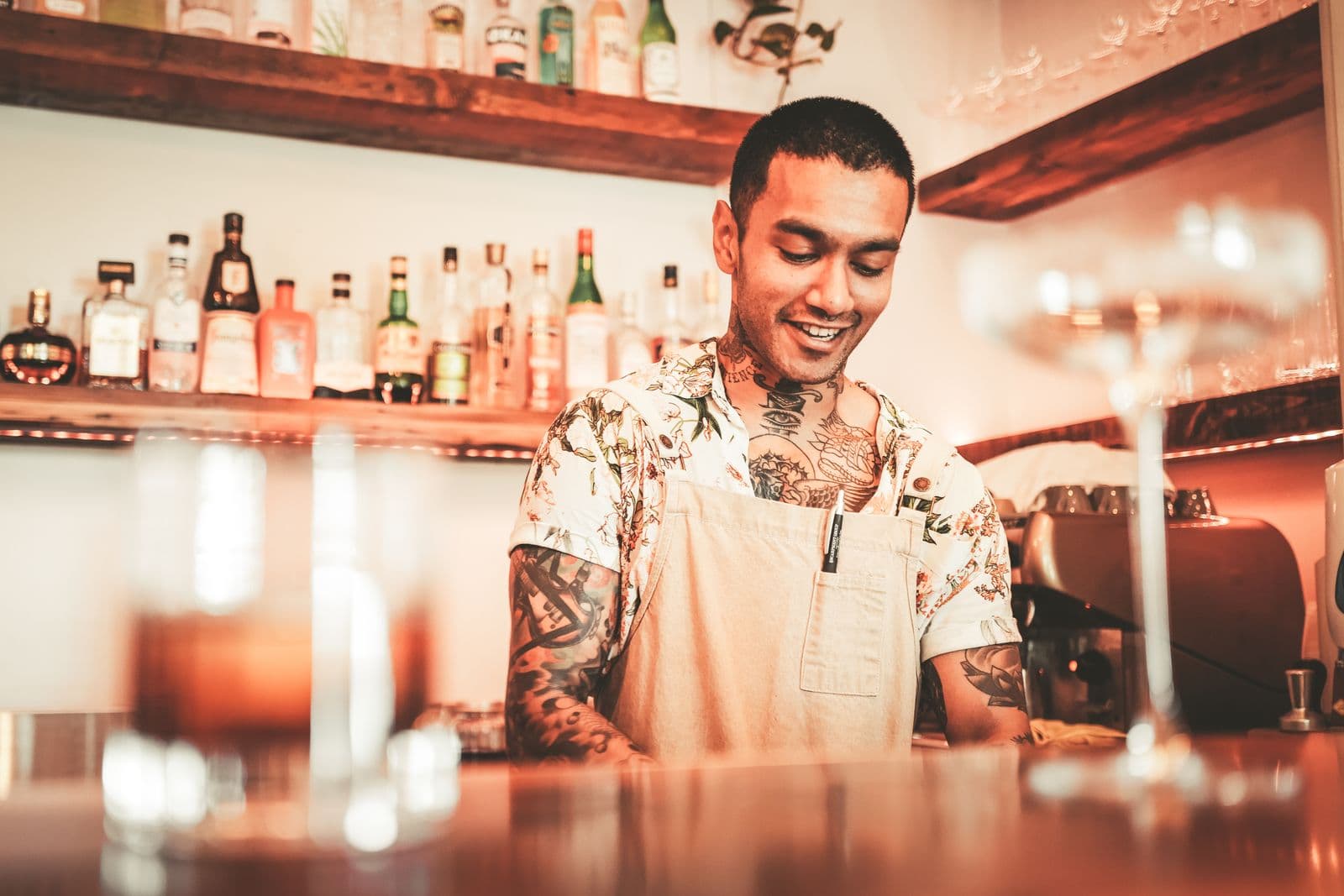
Modern bar operators describe showmanship through a "bar as theatre" framework: there is an experience script, staff step into "performance" rather than "service", bar seats are the front row, personalised tools are props, and there are weekly rehearsals. A bartender strong in showmanship writes the story of the bar — characters, setting, plot — rather than merely completing orders.
A major inspiration for contemporary showmanship is omotenashi — the Japanese philosophy of hospitality that grew out of the host's role in the tea ceremony: anticipating a guest's needs before they speak, and turning the preparation ritual itself into the experience. Glasses are pre-chilled, ice is treated with care, stirring is rhythmic, almost meditative — every step is part of a quiet performance.
So showmanship does not exclude flair — it contains it: a bottle toss is one scene in the play; attentiveness, rhythm and guest connection are the play itself.
Nearly 170 years of history: from the Blue Blazer to the movie Cocktail
Jerry Thomas (1830–1885) is claimed as founding father by both schools. His signature performance — the Blue Blazer — sent a stream of flaming whisky arcing between two metal tumblers; historians note the fire was almost purely theatrical. Beyond the bar he was a showman in the fullest sense: diamonds from cufflinks to rings, and he once dropped leaflets from a hot-air balloon to promote his London shows.
Modern flair exploded out of the TGI Friday's chain in the mid-1980s: the chain noticed bartender John Mescall juggling as he mixed, then ran its first internal flair competition (sources date it 1986–1987) and took it worldwide in 1991. The winner — John "J.B." Bandy — went on to train Tom Cruise for Cocktail (1988), the film widely credited as the spark that ignited the late-twentieth-century explosion of performance bartending.
Professional milestones followed: the Flair Bartenders' Association (FBA) was founded in 1997 in Orlando under the motto "Service First | Flair Second | Competition Always"; the Roadhouse World Flair competition began in London in 1999, held its first official final in 2000, and is widely considered the most prestigious flair championship; the World Flair Association (WFA) launched its Grand Slam series in 2008. The 2003–2008 stretch is remembered as flair's golden era, with major prize money at top events and Las Vegas as its capital.
Then the craft cocktail movement flipped the industry's priority to drink quality over spectacle. But the boundary is blurring again — as flair champion Tomek Małek puts it: "The days of saying, 'This is a flair bar,' 'That's a cocktail bar,' are over. You will see guys using flair techniques in Top 50 bars eventually."
Technique, side by side: flair moves vs showmanship skills
Flair is hard the way sport is hard: every move has a name and a standard, drilled until muscle memory takes over. Showmanship is hard the way theatre is hard: there is no fixed move list — what you train is reading guests, holding a rhythm, and a polish you can repeat every single night.
The table below sets signature flair moves (per European Bartender School and Userve teaching materials) against showmanship skills the industry actually recognises — the showmanship column is drawn straight from IBA judging criteria and the bar-as-theatre framework.
What both share: a foundation of solid bartending technique — pour control, tool handling, a clean station. Without it, flair collapses into disconnected juggling and showmanship into acting that hides flaws.
| Flair (named moves) | Showmanship (skills) |
|---|---|
| Tin spin — a frisbee-like wrist flick spinning the tin on your palm | Interaction — engaging guests and the crowd (a 25-point IBA criterion) |
| Stall — balancing a bottle or tin under control on the back of the hand or elbow | Preparation ritual — pre-chilled glassware, careful ice work, rhythmic stirring (the omotenashi spirit) |
| Bump — bouncing the object off the body to keep it spinning (community records exceed 300 consecutive bumps) | Storytelling — writing the story of the bar and the drink (bar-theatre framework) |
| Shadow pass — throwing the object behind the head to the other hand | Neatness & cleanliness — two 25-point IBA criteria |
| Helicopter — the object rotating on a horizontal axis like rotor blades | Confidence & pacing — smooth, assured execution (IBA Execution criteria) |
Choosing a style for your venue
The Flair Bartenders' Association itself puts "service and sales first, flair second" and stages exhibition routines as separate events outside working shifts — the world's biggest flair body acknowledging that choreographed routines do not belong to a busy service hour. Working flair, by definition, must not slow service; exhibition flair needs its own stage.
Risk is measurable too: under IBA rules, breaking a bottle costs 20 points — four times a drop (5) and ten times a spill (2). In real life, glass shattering mid-rush costs far more. That is why lean venues choose craft flair or pure showmanship over exhibition routines.
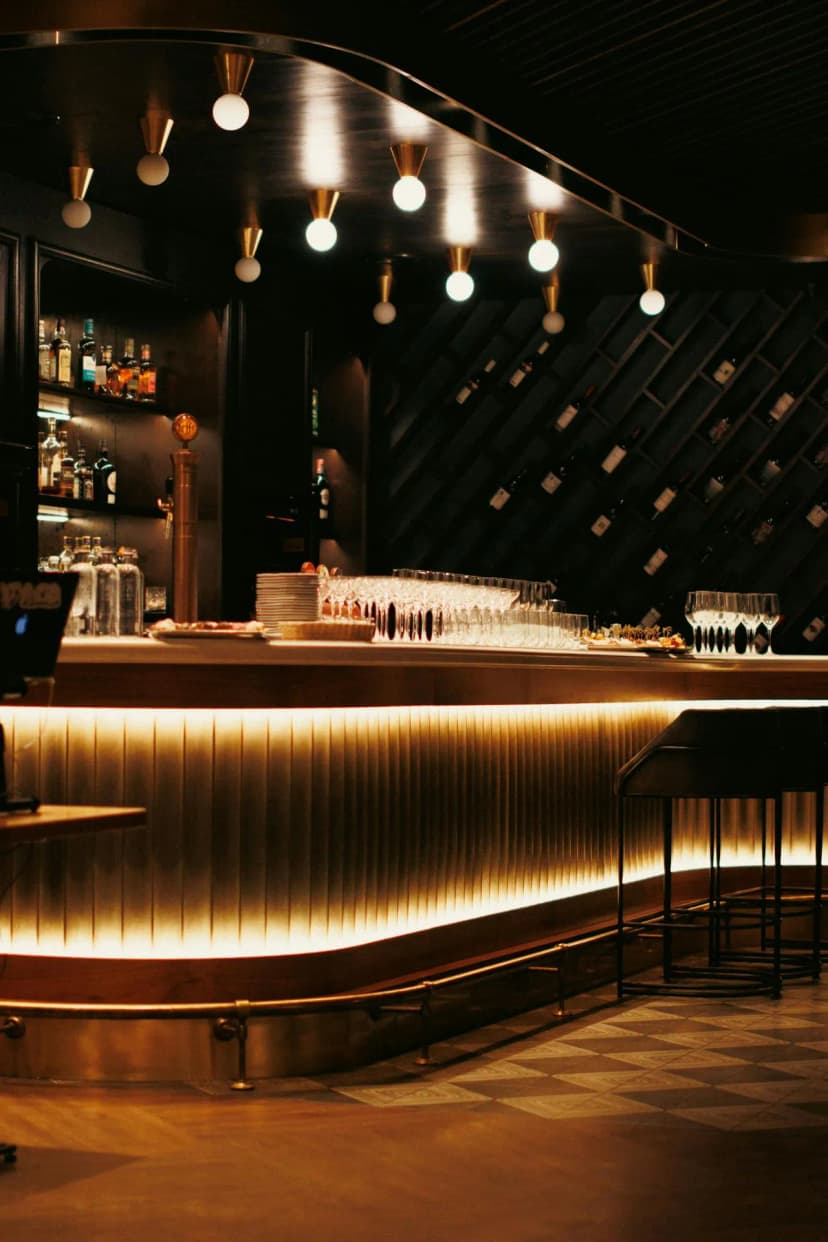
By venue type: clubs, beach bars and large events are where flair pays off — guests come to be entertained; speakeasies, quiet lounges and hotel bars favour ritual-driven showmanship and storytelling; cafés and event mocktail bars sit best with craft flair — a smooth accent that never taxes service speed. For weddings and corporate events, a bartender who balances both — a few beats of working flair when the room allows, immaculate composure the rest of the night — is usually the safest, classiest choice.
Training and competition: a path for Vietnamese bartenders
On training: international bartending schools now teach flair as its own course — the European Bartender School runs a dedicated working-flair course; beginners are advised to drill with lightweight practice bottles before real glass, because "many bottles will fall" is a certainty. Showmanship has no packaged course — it is built behind the bar, by observing guests and rehearsing the experience as a team.
On competition: the IBA Flairtending rules weigh both schools in one scoresheet — up to 450 technical points per judge, where Difficulty & Presentation carries 250 (variety, difficulty, music timing, originality, working flair) but Appearance & Interaction plus Execution together carry another 200 with purely showmanship criteria such as crowd interaction, neatness and confidence — plus up to 225 points for the drink itself (appearance, aroma, taste balance). Routines run 5 minutes in qualifiers and finals, 10 in the Super Final. The WFA ranks athletes over a rolling 52-week cycle with fixed points per event tier (Grand Slam 2000, Masters 500, Open 250, Challenger 120) and judges sequences rather than isolated moves.
The takeaway for Vietnamese bartenders: don't pick a side. The international scoresheets already answered — flair technique is only one slice; the rest is showmanship and the quality of the drink. Bartender.com.vn is building a community and stage for both paths: start with the foundational bartending programme under Training, sharpen technique through this Library, and when you're ready, bring your stagecraft to the platform's competitions.
Frequently asked questions
What is flair bartending?
A style of bartending that adds semi-acrobatic moves (bottle tosses, shaker spins, high pours) to entertain and impress guests while making a drink — per The Oxford Companion to Spirits & Cocktails.
Is showmanship the same as flair?
No. Flair is a performance-technique subset; showmanship covers the whole experience — interaction, ritual, storytelling. In IBA rules, Showmanship is its own 20-point criterion, separate from move difficulty.
How do working flair and exhibition flair differ?
Working flair uses the real bottles in service and must not slow it down; exhibition flair is a choreographed routine with bottles pre-set below about 60ml, judged more on technique and difficulty than cocktail quality.
Who started both schools?
Jerry Thomas (1830–1885) with the Blue Blazer — flaming whisky poured between two metal tumblers; TGI Friday's modernised flair in the mid-1980s and the film Cocktail (1988) took it mainstream.
How are flair competitions penalised?
Under IBA 2019 rules: a drop costs 5 points, a spill 2, breakage 20, flairing an empty bottle 5 per bottle, and overtime 10 points per 20 seconds.
Which style should my venue choose?
Clubs, beach bars and big events suit flair; speakeasies, lounges and hotel bars suit ritual showmanship; lean venues should start with craft flair — a smooth accent that never trades away service speed.
Sources
Flair bartending — The Oxford Companion to Spirits & Cocktails — https://www.spiritsanddistilling.com/dictionary/acref-9780199311132-e-897
Flair bartending — Wikipedia — https://en.wikipedia.org/wiki/Flair_bartending
Jerry Thomas: The Professor of Modern Bartending — Difford's Guide — https://www.diffordsguide.com/encyclopedia/2882/people/jerry-thomas
About the FBA — Flair Bartenders' Association — https://fbaarchives.org/about.cfm
Welcome to the World of Elite Flair — Punch — https://punchdrink.com/articles/welcome-to-world-of-elite-flair-bartending-competition/
The Rise and Fall of Flair Bartending — Tales of the Cocktail Foundation — https://talesofthecocktail.org/rise-and-fall-flair-bartendingand-why-it-might-rise-again/
The basics of flair bartending & 13 Essential Flair Moves — European Bartender School — https://www.barschool.net/blog/what-flair-bartending
World Cocktail Championships Rules & Regulations 2019 (Flairtending) — IBA — https://www.readkong.com/page/rules-regulations-2019-international-bartenders-9876190
Planning an event?
Get a free quote
Tell us about your event and our team will recommend the right package and send a detailed quote — no commitment.